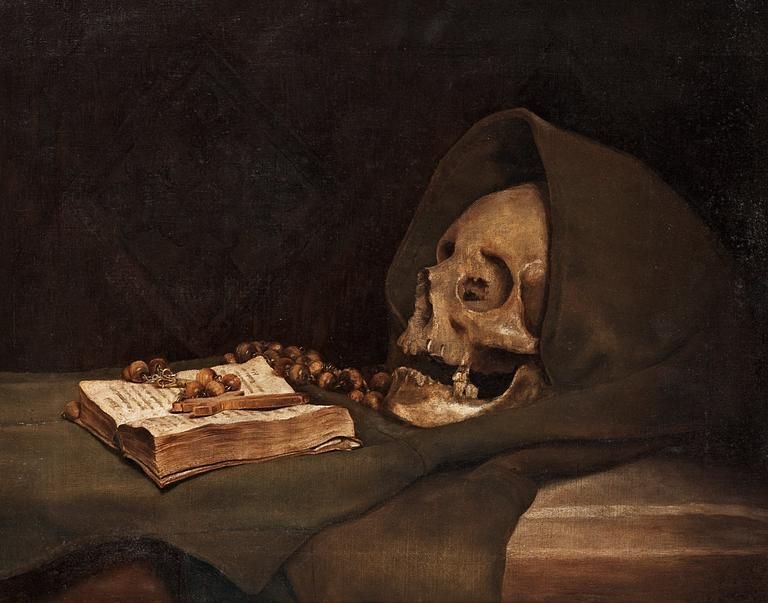
“As we enter Heaven, we will see them, so many of them, coming towards us and thanking us. We will ask them who they are, and they will answer: ‘A poor soul you prayed for in Purgatory.’”
– Venerable Archbishop Fulton J. Sheen
Autumn is my favorite time of year, partly because I love contemplating death, strange as that may sound. I certainly love the beautiful weather and the trees changing colors, but I think what I love most about this season is that the reality of death is at the forefront of our minds — or at least it should be. As we see the leaves falling from the trees and the grass turning brown, we should be reminded that nothing in this world lasts forever; everything that lives will one day die, and we’d do well to take this cue to reflect on our own mortality.
It’s fitting, then, that the Church sets aside time each year during this season to honor and pray for the dead in a special way. This begins with a succession of holy days called The Triduum of Death, or Hallowtide — October 31st (All Hallow’s Eve), November 1st (All Hallow’s Day, aka. the Solemnity of All Saints), and November 2nd (the Solemnity of All Souls). It doesn’t end there, though; the entire month of November is dedicated to the Holy Souls in Purgatory. While Catholics pray for the dead every single day — at Mass, in the Divine Office prayers, and in our own private prayers — we are encouraged throughout November to focus even more intently on praying and sacrificing for the souls in Purgatory.
If you haven’t yet, I do suggest reading my post on Purgatory either before or after reading this one, since Christian prayer for the dead cannot be fully understood or appreciated without also understanding Purgatory. As I explain in the aforementioned post, neither those in Heaven nor those in Hell can benefit from our prayers, so anytime a Christian prays for the dead we’re praying specifically for souls in Purgatory. By implication, this means that whenever we find evidence in history and Scripture of our Christian ancestors (and the Israelites before them) praying for the dead, this is evidence that they believed in what we have come to call Purgatory, even if that specific word wasn’t used.
So, what evidence is there in Scripture and history for the practice of praying for the dead? And why exactly do we do it? My hope is that this discussion will give you a greater appreciation for the ancient tradition of praying for the dead, and that you’ll leave here encouraged to take up this practice yourself, or, if you already do it, to dedicate yourself to it even more passionately.
Let’s begin by talking about the fundamental theological truths which underlie this practice.
The Mystical Body of Christ
The following is an excerpt from the Catholic Encyclopedia entry on Prayers for the Dead:
Coming to the proof of this doctrine, we find, in the first place, that it is an integral part of the great general truth which we name the communion of saints. . .
Men are not isolated units in the life of grace, any more than in domestic and civil life. As children in Christ’s Kingdom, they are as one family under the loving Fatherhood of God; as members of Christ’s mystical body, they are incorporated not only with Him, their common Head, but with one another, and this not merely by visible social bonds and external co-operation, but by the invisible bonds of mutual love and sympathy, and by effective co-operation in the inner life of grace. Each is in some degree the beneficiary of the spiritual activities of the others, of their prayers and good works, their merits and satisfactions. . .
Now, as between the living, no Christian can deny the reality of this far-reaching spiritual communion; and since death, for those who die in faith and grace, does not sever the bonds of this communion, why should it interrupt its efficacy in the case of the dead, and shut them out from benefits of which they are capable and may be in need?
Christians, by virtue of our baptism, are made members of Christ’s Body in a mystical way (see I Corinthians 12:12-31; Colossians 1:18; 2:18-20; Ephesians 1:22-23; 3:19; 4:13). This is the cause of our deep communion with one another; our unity with each other results from our unity with Christ, because if we’re all united to Christ, it follows that we’re also thereby united to one another. And because of this unity which we share in Christ, one individual’s actions end up affecting the entire Body of Christ, for better or for worse.
This is the basis for the doctrine of the Communion of Saints, which teaches us that all who are in communion with Christ can pray and sacrifice for each other, and these prayers and sacrifices will be especially efficacious because of our profound bond. I mentioned in my post on Mortal Sin & Venial Sin that in the first letter of Saint John, he teaches the faithful that we are to pray for those who are in venial sin and God will give them life, but he makes it clear that he’s not telling us to pray for those who are in mortal sin, because they have broken their communion with Christ, and by extension with the members of Christ’s Body, which means that our prayers cannot help the person like they could have when the person was united to Christ.
The Flow of Grace
This isn’t to say that Christians should never pray for non-Christians, or for those in mortal sin; what Saint John means is that our prayers cannot directly bring grace to these people like with fellow members of Christ’s Body, because these people are severed from Christ’s Body. We can certainly still pray that God brings these people to repentance and faith, but this is an ontologically different thing than praying and sacrificing for fellow members of the Body of Christ. Our Lord provides a helpful analogy:
“I am the true vine, and my Father is the vine grower. . .
Just as a branch cannot bear fruit on its own unless it remains on the vine, so neither can you unless you remain in me. I am the vine, you are the branches. Whoever remains in me and I in him will bear much fruit, because without me you can do nothing. Anyone who does not remain in me will be thrown out like a branch and wither; people will gather them and throw them into a fire and they will be burned.
(John 15:1,4-6)
Much like nutrients flow throughout a vine and all of its branches, giving them life, so does Christ’s grace flow throughout all who are members of His Body, giving us Divine life. And because we are not mere plants, but conscious beings with intellect and will, we can actively participate in this process, directing the flow of grace to some degree within the Body of Christ — this is what prayer and sacrifice does.
When we focus our prayers and sacrifices on a specific person, we are directing the flow of grace to them in a unique way, so that they will receive more grace than they otherwise would have without our prayers and sacrifices for them. And it’s important to understand that the grace of God is not a “zero sum game”, meaning that if one person is receiving more grace, this does not thereby take grace away from someone else. God’s grace is endless, and more grace for one person does not mean less grace for others — His grace is infinite.
So, when someone is in mortal sin, they are cut off from the flow of grace within the Body of Christ, which means that our prayers and sacrifices cannot directly bring them grace — in such cases, all we can do is ask God to bring them back into communion with Him. But what about those who have died? Does physical death sever our connection to the body of Christ? By no means!
Not the God of the Dead
It is crucial to understand is that this deep spiritual bond which we share as members of Christ’s Body is not broken by our bodily death, because those who die in communion with Christ are not truly dead, but still live in Him:
And concerning the resurrection of the dead, have you not read that which was spoken by God, saying to you:
“I am the God of Abraham, and the God of Isaac, and the God of Jacob”?He is not the God of the dead, but of the living.
— Matthew 22:31-32
Jesus said to her, “I am the resurrection and the life; he who believes in me, though he die, yet shall he live, and whoever lives and believes in me shall never die.”
— John 11:25-26
While we can rightly still refer to the people who have gone to Purgatory or to Heaven as “dead”, we need to recognize that there are two types of death: physical death, and spiritual death. Those in Purgatory and Heaven have undergone physical death, but not spiritual death (the spiritually dead are those in mortal sin and those in Hell), and this is why we can say that we pray for “the dead”, but also affirm that those who live in communion with Christ will never truly die — we are using the terms dead/die in two different senses.
The souls in Purgatory are alive in Christ just as the Saints in Heaven are, they simply haven’t fully completed their sanctification process yet. But the souls in Purgatory are still members of Christ’s Body, living branches on the Vine, so the grace of our prayers and our sacrifices can still flow from us to them like nutrients flowing throughout the vine. And just like us, the souls in Purgatory need all of the grace that they can get, because although they have the assurance of Heaven they must still endure a great deal of suffering before they get there, as all of their impurities and sinful attachments are burned away by the fire of God’s love.
In this life, we’re experiencing something similar, so we know that our sanctification requires suffering, but in Purgatory we might say that this process is intensified — the fire grows hotter as we draw closer to God. And just as with our fellow Christians on earth, we can pray for them and offer sacrifices to God on their behalf, and our prayers and sacrifices will bring them grace and help to ease the pain that they must endure. To quote Father Paul O’Callaghan, in an interview he did with CNA: “Purgatory is not an individualistic doctrine, where I sort of resolve and sort out my particular personal problems and sins and faults. It’s something that the whole Church does together. […] Christ is our Savior. Christ is the one who frees us from our sins. But since the Church is the Body of Christ, the Church also cooperates in that process. And that’s why the prayer of Christians is so, so valuable and so important.”
This practice of praying for the dead is not a later development of the Catholic Church either, as some like to claim, but it is in fact a very ancient idea, which dates back not only to the beginning of Christianity, but much earlier — the ancient Israelites, our spiritual ancestors, engaged in this practice too.
Evidence In Sacred Scripture
Probably the most detailed Scripture passage on praying for the dead is found in the second book of Maccabees. In chapter twelve, we’re told that Judas Maccabeus and members of his military are collecting the bodies of their fallen comrades who had been killed in battle, so that they may bring them home “to lie with their kinsmen in the sepulchers of their fathers.” But as they’re gathering the bodies, they make a discovery:
Then under the tunic of every one of the dead they found sacred tokens of the idols of Jam′nia, which the law forbids the Jews to wear. And it became clear to all that this was why these men had fallen. So they all blessed the ways of the Lord, the righteous Judge, who reveals the things that are hidden; and they turned to prayer, beseeching that the sin which had been committed might be wholly blotted out. And the noble Judas exhorted the people to keep themselves free from sin, for they had seen with their own eyes what had happened because of the sin of those who had fallen. He also took up a collection, man by man, to the amount of two thousand drachmas of silver, and sent it to Jerusalem to provide for a sin offering. In doing this he acted very well and honorably, taking account of the resurrection. For if he were not expecting that those who had fallen would rise again, it would have been superfluous and foolish to pray for the dead. But if he was looking to the splendid reward that is laid up for those who fall asleep in godliness, it was a holy and pious thought. Therefore he made atonement for the dead, that they might be delivered from their sin.
— II Maccabees 12:40-46
In this passage, it is revealed that:
- We can pray for other people’s sins to be forgiven.
- Sins can potentially be forgiven even after death.
- We can offer prayers and sacrifices on behalf of the dead.
- This is a “holy and pious” thing to do.
Now, although this book Second Maccabees is in Catholic and Orthodox Bibles, it is not in the Protestant canon of Scripture, because it was removed during the Reformation, so Protestants do not consider this text to be inspired by God. But even if we simply take it as a historical document, it proves that the Israelites — God’s chosen people — believed that it was good and holy to pray for the dead, and that our prayers and sacrifices on their behalf could be efficacious and help to save their souls from suffering. Realize too that this was before Christ came, so they didn’t even have the concept of the Body of Christ or the Communion of Saints, yet they still believed in praying for the dead. Also worth noting is that when Christ did come, He didn’t tell them to stop; there were several different corrections that Jesus made to the practices of the Israelites in His day, plenty of things that He criticized them for and told them to stop doing, but praying for the dead wasn’t one of them. And being an Israelite Himself, He would have been raised with their traditions, including the tradition of praying for the dead.
There are a few passages in the New Testament which could be interpreted as the Apostles praying for people who have died, but they’re not definitive and could be interpreted in other ways too, so I don’t think they’re worth spending time on here. Like I’ve mentioned though, Purgatory and praying for the dead go hand in hand, one implies the other, so if you’d like more biblical evidence that indirectly supports praying for the dead, see my post on Purgatory where I provide ample biblical evidence for that doctrine.
Finally, as I always like to do, let’s take a look at what some of the Church Fathers wrote about praying for the dead.
The Church Fathers
“We offer sacrifices for the dead on their birthday anniversaries [the date of death, their birth into eternal life]” (Chaplet 3, A.D. 211)
“A woman, after the death of her husband . . . prays for his soul and asks that he may, while waiting, find rest; and that he may share in the first Resurrection. And each year, on the anniversary of his death, she offers the sacrifice.” (Monogamy 10, c. A.D. 218)
— Tertullian of Carthage
“Then we commemorate also those who have fallen asleep before us, first patriarchs, prophets, apostles, martyrs, that at their prayers and intercessions God will receive our petition. Then on behalf of the holy fathers and bishops who have fallen asleep before us, and in a word all who in past years have fallen asleep among us, believing that it will be a very great benefit to the souls for whom the supplication is put up, while that holy and most awful sacrifice is set forth.” (Catechetical Lectures 23:9, c. A.D. 350)
— Saint Cyril of Jerusalem
“Let us then give them aid and perform commemoration for them. For if the children of Job were purged by the sacrifice of their father, why do you doubt that when we too offer for the departed, some consolation arises to them, since God is wont to grant the petitions of those who ask for others?” (Homilies on First Corinthians 41:8, c. A.D. 392)
“Mourn for those who have died in wealth, and did not from their wealth think of any solace for their soul, those who had power to wash away their sins and would not. […] Let us weep for these; let us assist them according to our power; let us think of some assistance for them, small though it be, yet still let us assist them. In what way? By praying and entreating others to make prayers for them, by continually giving to the poor on their behalf.” (Homilies on Philippians 3, c. A.D. 402)
— Saint John Chrysostom
“There is an ecclesiastical discipline, as the faithful know, in which the names of the martyrs are read aloud in that place at the altar of God where prayer is not offered for them. Prayer, however, is offered for other dead who are remembered. It is wrong to pray for a martyr, to whose prayers we ought ourselves be commended.” (Sermons 159:1, c. A.D. 411)
“During the time, moreover, that intervenes between a man’s death and the final resurrection, the soul dwells in a hidden retreat, where it enjoys rest or suffers affliction in proportion to the merit it earned by the life it led on earth. Nor can it be denied that the souls of the dead are benefited by the piety of their living friends, who offer the sacrifice of the Mediator, or give alms in the church on their behalf.” (ibid., 109–10)
— Saint Augustine of Hippo
Also worth noting is that there are many inscriptions in the catacombs on early Christian tombs, dated to the first few centuries, which ask whoever reads the inscriptions to pray for the souls of the departed Christians who were buried there. So, between the archeological evidence and the written evidence from the Fathers of the Church, it’s clear that praying for the dead has been a universal Christian practice since the very beginning of our faith.
Conclusion
I hope you’ve learned a few things from what I’ve shared here, and above all that you’ve gained a greater appreciation for the practice of praying for the dead. It’s such a beautiful aspect of our faith, such a profound blessing which is made possible only through the love and mercy of Our Lord. Those who have died in communion with Christ — even a very imperfect communion — are still intimately connected to us by virtue of our shared union with Christ. We are all one Body: the Saints in Heaven, the Holy Souls in Purgatory, and us, the Church Militant still on earth. We’re a family, and loving each other and praying for each other and sacrificing for each other is what Christianity is all about.
We’ll end with a very fitting quote from Pope Benedict XVI:
“The belief that love can reach into the afterlife, that reciprocal giving and receiving is possible, in which our affection for one another continues beyond the limits of death — this has been a fundamental conviction of Christianity throughout the ages, and it remains a source of comfort today. Who would not feel the need to convey to their departed loved ones a sign of kindness, a gesture of gratitude, or even a request for pardon?
Now a further question arises: if “Purgatory” is simply purification through fire in the encounter with the Lord, Judge and Saviour, how can a third person intervene, even if he or she is particularly close to the other? When we ask such a question, we should recall that no man is an island, entire of itself. Our lives are involved with one another, through innumerable interactions they are linked together. No one lives alone. No one sins alone. No one is saved alone. The lives of others continually spill over into mine: in what I think, say, do and achieve. And conversely, my life spills over into that of others: for better and for worse.
So my prayer for another is not something extraneous to that person, something external, not even after death. In the interconnectedness of Being, my gratitude to the other — my prayer for him — can play a small part in his purification. And for that there is no need to convert earthly time into God’s time: in the communion of souls, simple terrestrial time is superseded. It is never too late to touch the heart of another, nor is it ever in vain.”
(Encyclical Letter ‘Spe Salvi’, On Christian Hope, paragraph 48)
I hope you’ll join me in praying often for our departed brothers and sisters, and offering sacrifices to God on their behalf. Because someday, by the grace of Jesus Christ, we’ll be in Purgatory ourselves, relying on the prayers of others to ease our suffering. And I think it’s a safe bet that if we pray for them, they’ll pray for us in return, and someday we’ll all meet in Heaven, where we’ll finally get to express our gratitude to one another with a warm and loving embrace, each saying to the other: “Thank you so much for your help, it really made all the difference.”
May my brother Ethan, my Grandma Dolly, all of your departed loved ones, and all of the faithful departed, through the mercy of God, rest in peace.
God love you.
 Via Logos Agape