Then God’s temple in Heaven was opened,
(Revelation 11:19 – 12:2)
and the Ark of His Covenant was seen within His temple;
and there were flashes of lightning,
loud noises, peals of thunder,
an earthquake, and heavy hail.
And a great wonder appeared in Heaven,
a woman clothed with the sun,
with the moon under her feet,
and on her head a crown of twelve stars;
she was with child,
and she cried out in her pangs of birth,
in anguish for delivery.
To begin my series on Mary, I previously discussed her divine motherhood — the fact that she is the mother of God Incarnate, Jesus Christ. That is certainly the most fundamental role of Mary, but several other roles and realities related to Mary actually follow from this one.
Mary’s Divine motherhood is one of the four Marian Dogmas infallibly defined by the Church, and I plan to cover the other three in future posts. But there are also typological realities associated with Mary, wherein certain figures from the Old Testament are now recognized to have been foreshadowing Mary (if you’re not very familiar with typology, you can read my brief explanation of it here). Studying and understanding these Marian types will actually help set the stage for us to better understand the Marian dogmas, and will also help us see more clearly why Mary is so very important to Catholics — why we treat her with such awe and veneration — which is why I thought we should cover a few of these types first.
The first Marian type we’re going to discuss is the Ark of the Covenant. Most of us are familiar with the Ark, even if only from the classic Indiana Jones film Raiders of the Lost Ark. But the Ark of the Covenant is no mere fantasy, it was a real object in ancient Israel — the single holiest, most sacred object on earth at the time. In order to best see why the Ark was so sacred, and how exactly it prefigured Mary, we’ll begin with some key details about the Ark of the Covenant from the Old Testament.
The Origin and Purpose of the Ark
The Ark of the Covenant was created by Divine decree. Most of us are somewhat familiar with the story of the Exodus, when Moses led the Israelites out of slavery in Egypt, only to take a forty-year journey through the desert toward the promised land. Early on in this journey, Moses is given the Ten Commandments atop Mount Sinai, but what you may not know is that before He gives Moses the Ten Commandments, God commands Moses to build a portable sanctuary for Him — called a Tabernacle — where He will dwell with the Israelites on their journey. We read in Exodus 25:
8 And let them make me a sanctuary, that I may dwell in their midst. 9 According to all that I show you concerning the pattern of the Tabernacle, and of all its furniture, so you shall make it. 10 “They shall make an Ark of acacia wood; two cubits and a half shall be its length, a cubit and a half its breadth, and a cubit and a half its height. 11 And you shall overlay it with pure gold, within and without shall you overlay it, and you shall make upon it a molding of gold round about. 12 And you shall cast four rings of gold for it and put them on its four feet, two rings on the one side of it, and two rings on the other side of it. 13 You shall make poles of acacia wood, and overlay them with gold. 14 And you shall put the poles into the rings on the sides of the Ark, to carry the Ark by them. 15 The poles shall remain in the rings of the Ark; they shall not be taken from it. 16 And you shall put into the Ark the Testimony which I shall give you. 17 Then you shall make a Mercy Seat of pure gold; two cubits and a half shall be its length, and a cubit and a half its breadth. 18 And you shall make two cherubim of gold; of hammered work shall you make them, on the two ends of the Mercy Seat. 19 Make one cherub on the one end, and one cherub on the other end; of one piece with the Mercy Seat shall you make the cherubim on its two ends. 20 The cherubim shall spread out their wings above, overshadowing the Mercy Seat with their wings, their faces one to another; toward the Mercy Seat shall the faces of the cherubim be. 21 And you shall put the Mercy Seat on the top of the Ark; and in the Ark you shall put the Testimony that I shall give you. 22 There I will meet with you, and from above the Mercy Seat, from between the two cherubim that are upon the Ark of the Testimony, I will speak with you of all that I will give you in commandment for the people of Israel.
So, the Tabernacle — and specifically the Ark within it — is going to be the dwelling place of God on earth, the location where God will commune with the Israelites. Note too how particular God is about the Ark’s design, which should indicate how important this object was to Him. Furthermore, the Ark would contain the tablets on which God carved the Ten Commandments; we know this is what He means above when He says “the Testimony that I shall give you”, because we read a few chapters later:
And He gave to Moses, when He had made an end of speaking with him upon Mount Sinai, the two tables of the Testimony, tables of stone, written with the finger of God.
Importantly, thanks to the Letter to the Hebrews (Hebrews 9:4), we know that two more objects were also kept in the Ark:
- A golden bowl containing some of the manna from Heaven that God gave to the Israelites to eat while in the desert (Exodus 16)
- The staff of the high priest Aaron (Numbers 17)
So, how does all of this relate to Mary?
What Mary Contained
The clearest and most obvious parallel is that, just like the Ark, Mary became the dwelling place of God on earth, when she bore Christ in her womb.
Going a bit deeper though, we can see how the specific objects that were contained within the Ark were actually types of Christ.
The New Testimony of God
If you’ve seen the third season of the popular Christian television series ‘The Chosen’, you’ll know that when a rabbi was rebuking Jesus for claiming to be the Son of God, the rabbi told Jesus that if He did not renounce His words, the Jews would have no choice but to follow the Law of Moses (to execute Him for blasphemy), to which Jesus responds:
“I AM the Law of Moses.”
While this is not a direct quote from Scripture, it is theologically accurate when properly understood. It is stated several times in the New Testament that Christ came to fulfill the Law, and it is clear that He Himself is to act as God’s new Testimony to mankind. This is perhaps demonstrated most clearly during the Sermon on the Mount, specifically in Matthew 5:17-48, where Christ cites commandments of the Law with the phrase “You have heard that it was said…” and then gives His new commandments, which supersede these old commandments, using the phrase “But I say to you…”
It’s also worth noting that Christ gives these commandments on a mountain, just as Moses received the original Ten Commandments on a mountain. To quote a footnote in the Ignatius Catholic Study Bible: “The Sermon on the Mount encapsulates the Law of the New Covenant. […] The setting recalls the giving of the Law on Mt. Sinai (Exodus 19-24).”
So, the Ark contained the original Law/Testimony of God, and Mary contained the new Law/Testimony of God: Jesus Christ. I’ve also heard people like Scott Hahn frame it as the Ten Commandments being the word of God in stone, and Jesus being the Word of God in flesh; either way, the point remains the same.
The New Manna from Heaven
During the Bread of Life discourse in the sixth chapter of the Gospel of John, Jesus very explicitly tells us that He is the new/true manna/bread from Heaven:
“Truly, truly, I say to you, it was not Moses who gave you the bread from heaven; my Father gives you the true bread from heaven. For the bread of God is that which comes down from heaven, and gives life to the world.” They said to him, “Lord, give us this bread always.” Jesus said to them, “I am the bread of life […] Your fathers ate the manna in the wilderness, and they died. This is the bread which comes down from heaven, that a man may eat of it and not die. I am the living bread which came down from heaven; if any one eats of this bread, he will live for ever; and the bread which I shall give for the life of the world is my flesh.”
So, the Ark contained the original manna from Heaven, and Mary contained the New Manna from Heaven: Jesus Christ.
The New High Priest
The Staff of Aaron, which was kept in the Ark, represented the Old Covenant High Priesthood, and Christ Himself is the New Covenant High Priest:
Therefore, since we have a great high priest who has ascended into heaven, Jesus the Son of God, let us hold firmly to the faith we profess. For we do not have a high priest who is unable to empathize with our weaknesses, but we have one who has been tempted in every way, just as we are—yet he did not sin.
So, the Ark contained the symbol of the original high priesthood, and Mary contained the new High Priest Himself.
All of these parallels are clear and undeniable, but in fact we are far from finished. Saint Luke, in the first chapter of his Gospel, takes us by the hand and leads us quite directly from the Ark to Mary.
Overshadowed
At the end of the book of Exodus, we’re told that once Moses completed the construction of the Ark and the Tabernacle, God came to dwell with the Ark as He had promised:
Then the cloud covered the tent of meeting, and the glory of the Lord filled the Tabernacle. Moses could not enter the tent of meeting, because the cloud overshadowed it and the glory of the Lord filled the Tabernacle.
The cloud that overshadowed the Tabernacle was the glory cloud — the Shekinah in Hebrew, which comes from their word for “dwelling”. The glory cloud was a visible sign of God’s presence in the Old Testament, mentioned many different times in different books, most often in reference to God’s dwelling with the Ark in the Tabernacle.
Jumping forward to the second book of Maccabees, we’re told about the ultimate fate of the Ark in the Old Testament:
It was also in the writing that the prophet [Jeremiah], having received an oracle, ordered that the tent and the Ark should follow with him, and that he went out to the mountain where Moses had gone up and had seen the inheritance of God. And Jeremiah came and found a cave, and he brought there the tent and the Ark and the altar of incense, and he sealed up the entrance. Some of those who followed him came up to mark the way, but could not find it. When Jeremiah learned of it, he rebuked them and declared: “The place shall be unknown until God gathers his people together again and shows his mercy. And then the Lord will disclose these things, and the glory of the Lord and the cloud will appear, as they were shown in the case of Moses, and as Solomon asked that the place should be specially consecrated.”
So, the prophet Jeremiah has put the Ark to rest in a cave which he sealed shut, the location of which is unknown. And as he says at the end of that passage, the Ark will remain hidden until God gathers His people together again and shows His mercy, at which point “the glory of the Lord and the cloud will appear”, the obvious implication being that the glory of the Lord will overshadow the Ark again, revealing it’s location, just as the glory of the Lord had overshadowed the Ark in the time of Moses.
Knowing this prophecy from Jeremiah, we can read Gabriel’s words to Mary at the Annunciation in a whole new light:
And the angel said to her,
“The Holy Spirit will come upon you,
and the Power of the Most High will overshadow you;
therefore the child to be born will be called holy, the Son of God.
The original Greek word being translated as “overshadow” here in Luke’s Gospel is the very same Greek word, episkiazō, used in the Greek Septuagint version of the Old Testament (the version which Jesus and His Apostles used) whenever God’s glory cloud overshadowed the Ark.
So, God overshadowed Mary just as He overshadowed the Ark, which indicates — in light of all of the other evidence for Mary being the New Ark — that this was the sign prophesied by Jeremiah, revealing the location of the Ark, while at the same time showing His mercy by sending us our Savior: Jesus Christ. As is typically the case with prophecies, it was certainly fulfilled in an unexpected way, revealing the New Ark instead of the original. And if this were the only alleged connection between Mary and the Ark in Luke’s Gospel, we might be able to write it off as a coincidence, but Luke goes on to draw several more textual parallels between Mary and the Ark. In order to recognize them, we need to first look back at an event described in the Old Testament.
The Ark, King David, & The Visitation
In the second book of Samuel, there’s a story about King David traveling through the hill country of Judah with the Ark, with the goal of bringing the Ark into his capital city:
And David arose and went, with all the people who were with him, from Ba′al of Judah, to bring up from there the Ark of God, which is called by the name of the Lord of hosts who sits enthroned on the cherubim. And they carried the Ark of God upon a new cart, and brought it out of the house of Abin′adab which was on the hill.
[…]
And David was afraid of the Lord that day; and he said, “How can the Ark of the Lord come to me?” So David was not willing to take the Ark of the Lord into the city of David; but David took it aside to the house of O′bed-e′dom the Gittite. And the Ark of the Lord remained in the house of O′bed-e′dom the Gittite for three months; and the Lord blessed O′bed-e′dom and all his household. And it was told King David, “The Lord has blessed the household of O′bed-e′dom and all that belongs to him, because of the Ark of God.” So David went and brought up the Ark of God from the house of O′bed-e′dom to the city of David with rejoicing
[…]
And David danced before the Lord with all his might; and David was girded with a linen ephod. So David and all the house of Israel brought up the Ark of the Lord with shouting, and with the sound of the horn. As the Ark of the Lord came into the city of David, Michal the daughter of Saul looked out of the window, and saw King David leaping and dancing before the Lord.
(2 Samuel 6:2-3, 9-12, 15-16)
With this story fresh in our minds, let’s now look at Saint Luke’s account of Mary going to visit her cousin Elizabeth.
In those days Mary arose and went with haste into the hill country, to a city of Judah, and she entered the house of Zechari′ah and greeted Elizabeth. And when Elizabeth heard the greeting of Mary, the babe leaped in her womb; and Elizabeth was filled with the Holy Spirit and she exclaimed with a loud cry, “Blessed are you among women, and blessed is the fruit of your womb! And why is this granted me, that the mother of my Lord should come to me? For behold, when the voice of your greeting came to my ears, the babe in my womb leaped for joy.“
(Luke 1:39-44, 56)
And Mary remained with her about three months, and returned to her home.
Hopefully you caught at least a few of the parallels between this story and the story of David traveling with the Ark. Let’s break it down one by one:
- David “arose and went”; Mary “arose and went”.
- The Ark was traveling in the hill country of Judah; Mary was traveling in the hill country of Judah.
- David leapt before the presence of the Ark; John the Baptist leapt in Elizabeth’s womb before the presence of Mary. Also notable: we’re told that David was wearing a linen ephod, which was the garment worn by the high priest of Israel, and John the Baptist was a direct descendant of the original high priest Aaron.
- The Ark was brought up “with shouting”; Elizabeth “exclaimed with a loud cry” when she saw Mary, and in each case the same Greek word was used to describe the shouting, κραυγῇ/kraugé. Here we have a similar situation to the word “overshadowed”, in that its use in the Old Testament would almost always relate to the Ark of the Covenant; in this case, κραυγῇ described how the Levitical priests would sing to glorify the Ark and the Lord within it (see 1 Chronicles 15:28, 1 Chronicles 16:4-6, and 2 Chronicles 5:12-14). And so here we have Elizabeth, a descendant of the Levitical priesthood, praising Mary with this same liturgical singing, just as her priestly ancestors would sing before the Ark.
- David asked “How can the Ark of the Lord come to me?” and Elizabeth asked “Why is it that the mother of my Lord should come to me?”
- The Ark remained with O′bed-e′dom for three months; Mary remained with Elizabeth for “about three months”. We know that Elizabeth was six months pregnant when Mary arrived, so we can conclude that Mary stayed with Elizabeth until John was born, but ask yourself: why wouldn’t Luke simply say “Mary stayed with Elizabeth until John was born” or something to that effect? Instead, he made a point to say that she stayed for “about three months”, obviously intending to draw a parallel with the story of the Ark.
It must be understood that these parallels aren’t meant to be one-to-one; the story of David traveling with the Ark and the story of Mary visiting Elizabeth aren’t meant to directly mirror each other. Rather, Luke very intentionally includes several allusions to the story of David traveling with the Ark, because he wants the careful reader to understand that these two stories are related. To quote commentary from the Ignatius Catholic Study Bible: “Luke’s remarkable familiarity with these ancient stories enables him to select even a single word [like “overshadowed”/episkiazō or “shouting”/kraugé] that will whisper to his readers that this young Mother of the Messiah is the new Ark of the Covenant. […] By choosing his words and phrases carefully, he is able to weave various strands of biblical tradition into his narrative, adding beauty and depth to his already elegant prose.”
If you weren’t convinced that the Ark of the Covenant was a type of Mary when you began reading this post, hopefully at this point the accumulation of evidence is starting to convince you. Like I’ve said, any one of these Scripture passages or parallels between Mary and the Ark may not, on its own, seem very definitive, but when you take them all together the case becomes very difficult to deny. There are a couple more powerful pieces of evidence that we need to look at, though — the first of which isn’t directly about Mary or the Ark, but instead relates to Jesus Christ and Moses.
The New Exodus
The idea that Moses was a type of Christ, and therefore Christ is the new Moses, is explicitly found in the New Testament, and typological connections and literary allusions between Christ and Moses also permeate Scripture. This topic deserves its own post, and perhaps I’ll write one on it someday, but for the sake of brevity we’ll just take it as a given that Jesus Christ is the new Moses. Now, with this in mind, let’s take a look at the account of the Transfiguration in Luke’s Gospel:
About eight days after he said this, he took Peter, John, and James and went up the mountain to pray. While he was praying his face changed in appearance and his clothing became dazzling white. And behold, two men were conversing with him, Moses and Elijah, who appeared in glory and spoke of his exodus that he was going to accomplish in Jerusalem.
If Jesus is the new Moses, it only makes sense that He would lead God’s people on a New Exodus — but what exactly will be the nature of this New Exodus? Moses originally led God’s people out of the bondage of slavery in Egypt, and into the freedom of the Promised Land of Jerusalem. Likewise, Christ’s Exodus will lead God’s people out of the bondage of slavery to sin and death, and into the freedom of the Promised Land of Heaven. While Moses’ Exodus began in Egypt and ended in Jerusalem, Christ’s Exodus would begin in Jerusalem — with His Passion, Crucifixion, Death, and Resurrection — and end in Heaven. Revelation 11:8 even compares Jerusalem to Egypt, so it’s fitting that this would be the starting point of the New Exodus; Christ quite literally picks up where Moses left off, leading His people the rest of the way, to the ultimate promised land: Heaven.
Think back also to the Bread of Life discourse which I referenced earlier, where Christ says that He is the true manna from Heaven, and that we must eat His flesh and drink his blood in order to live, just as the Israelites wandering in the desert during the original Exodus relied on the manna from Heaven to survive. He then instituted the Eucharist at the Last Supper, finally giving His people this true manna of which He had spoken, because He knew that the New Exodus was upon us — He was about to begin the journey that would lead us all out of slavery to sin, towards the promised land of Heaven. And just like the original Exodus was initiated by the first Passover, the New Exodus was initiated by the new Passover; just as the Passover lamb was slaughtered and eaten by the Israelites right before they embarked on their Exodus, Christ our new Passover Lamb was slaughtered and eaten right before the New Exodus began.
But the Eucharist, the flesh of Christ, is not only the Passover Lamb, it is also the True Manna from Heaven. This life that we’re living right now as Christians is the journey through the desert, and we desperately need the Eucharist — the Manna from Heaven — to sustain us on this journey, just as the Israelites needed the manna during the first Exodus. I plan to write much more about the Eucharist in the future, because there’s just so much to say about it, but for now the point is that Christ clearly gave us the Eucharist to be our New Manna on this New Exodus.
However, as Dr. Brant Pitre points out in episode 2 of his Lectio: Mary series, if you were a first century Jew and you read in Luke’s Gospel that Jesus was going to accomplish an Exodus, one of the first questions you’d have is: where is the Ark? The original Exodus wasn’t just a trip through the desert, it was a pilgrimage guided by the Ark — wherever the Ark went, the Israelites went. The Ark of the Covenant was at the center of the journey to the promised land, it literally led them there, and Israel was only able to make that journey by following the Ark. Here’s just one example of Scripture describing how the Ark always went before them to guide them:
So they set out from the mount of the Lord three days’ journey;
and the Ark of the Covenant of the Lord went before them three days’ journey, to seek out a resting place for them.
But for Jesus’ followers, the fact that the Ark had been missing for centuries was a problem if they were going to embark on a New Exodus — a problem which was very much at the forefront of their minds, because they were constantly reminded of the Ark’s absence in their Temple worship. The Tabernacle which had housed the Ark during the Exodus was merely a precursor to the Temple which would later be built in Jerusalem, and the Ark was meant to be an integral part of Israel’s ritual worship. On the Day of Atonement, Yom Kippur, the priests would sacrifice a bull as a sin offering, go into the holy of holies where the Ark was kept within the Temple, and sprinkle the bull’s blood on the mercy seat of the Ark seven times, as God instructed in Leviticus 16. But after the Ark went missing, this was no longer possible, so the priests would simply sprinkle the blood on the ground in the empty room where the Ark was supposed to be. The first century Jewish historian Josephus wrote:
But the inmost part of the temple . . . was also separated from the outer part by a veil. In this there was nothing at all. It was inaccessible and inviolable, and not to be seen by any; and was called the Holy of Holies.
(War, 5.219)
The Israelites in Jesus’ day were anxiously awaiting God’s revelation of the location of the Ark which had been prophesied by Jeremiah. And while I’ve shown many different signs in Scripture which indicate that Mary is the New Ark, there’s one more major sign worth mentioning — a sign more explicit than any we’ve discussed thus far.
The Ark In The Promised Land
I quoted this excerpt from the book of Revelation at the very beginning of this post, but I’ll quote it again here just to refresh your memory:
Then God’s temple in Heaven was opened,
(Revelation 11:19 – 12:2)
and the Ark of His Covenant was seen within His Temple;
and there were flashes of lightning,
loud noises, peals of thunder,
an earthquake, and heavy hail.
And a great wonder appeared in Heaven,
a woman clothed with the sun,
with the moon under her feet,
and on her head a crown of twelve stars;
she was with child,
and she cried out in her pangs of birth,
in anguish for delivery.
Most of us today aren’t going to understand the full weight of this passage, but the Israelites in the early Church certainly would have. As we’ve established, the Israelites had been waiting hundreds of years for God to reveal the location of the Ark, and while Luke gives us very clear signs that Mary has been revealed as the New Ark, the Revelation of Saint John is fully explicit — the location of the Ark is confirmed: it has been brought home to its final resting place, God’s Temple in Heaven (this will be significant when we discuss Mary’s Assumption later in this series). Not only that, but this vision John has of the Ark in Heaven is superimposed with an image of the mother of the Messiah (who happens to be wearing a crown, which we’ll also get to later in this series). This woman is very obviously Mary, and Saint John is showing us, as Dr. Brant Pitre puts it, “overlapping symbols”, dual images that represent the same person, which he does elsewhere in the book of Revelation as well (both “the male child” and “the Lamb” are Christ; both “the serpent” and “the dragon” are Satan), so that we may see that both the Ark and the woman clothed with the sun are one and the same person: Mary.
What does all of this mean for us though, practically speaking? As I pointed out, on the original Exodus the Ark always went before the Israelites, leading them on their journey into the promised land. Likewise now, Mary the New Ark leads us on our pilgrimage to Heaven, and she has gone out ahead of us — carried into the promised land of Heaven — to show us the way, so that we may follow her there.
“When you see the Ark of the Covenant of the Lord your God being carried by the Levitical priests, then you shall set out from your place and follow it, that you may know the way you shall go, for you have not passed this way before. Yet there shall be a space between you and it […] And Joshua said to the people, “Sanctify yourselves; for tomorrow the Lord will do wonders among you.”
I don’t know about you, but I find all of this incredibly beautiful. Mary isn’t simply another Christian like the rest of us, as Protestants so often like to claim. Mary is our Ark — and not just the New Ark, but the True Ark. She is what the Ark of the Covenant was foreshadowing; the original Ark was merely a shadow of the woman who was to come. Mary, the True Ark, became the dwelling place of God, her sacred womb held the Word of God, the True Manna, the High Priest. And after we’ve been freed by Christ from slavery to sin and death, just as Moses freed the Israelites from slavery, Mary as the True Ark leads us on our journey to the True Promised Land of Heaven, going before us that we may know the way we shall go, for we have not passed this way before.
I hope you’ll take some time to reflect and pray on all of this, even if to simply thank Our Lord for giving us the incredible gift of His mother, and making her our guide on the difficult journey that we must take through this life.
As I always like to do, let’s look at a few excerpts from the writings of the Church Fathers, so that we may have a glimpse into what the early Christians believed.
The Fathers on Mary as the Ark
“Let us chant the melody that has been taught us by the inspired harp of David, and say, ‘Arise, O Lord, into thy rest; thou, and the Ark of thy sanctuary.’ For the Holy Virgin is in truth an Ark, wrought with gold both within and without, that has received the whole treasury of the sanctuary”
– Saint Gregory the Wonder Worker, ‘Homily on the Annunciation to the Holy Virgin Mary’ (c. AD 250)
“O noble Virgin, truly you are greater than any other greatness. For who is your equal in greatness, O dwelling place of God the Word? To whom among all creatures shall I compare you, O Virgin? You are greater than them all. O [Ark of the] Covenant, clothed with purity instead of gold! You are the Ark in which is found the golden vessel containing the true manna, that is, the flesh in which divinity resides. […] Truly he has given us his body, and we have eaten of it. That is how life came to all, and all have come to life by the mercy of God, your beloved Son.”
– Saint Athanasius of Alexandria, ‘Homily on the Virgin’ from the Papyrus of Turin (c. AD 300) [some historians are unsure whether this was actually written by Athanasius of Alexandria or by someone else, but that isn’t really relevant in my opinion; it’s still a writing from the early Church, so I decided to include it anyway]
“The prophet David danced, then. But what would we say that the Ark was if not holy Mary, since the Ark carried within it the Tables of the Covenant, while Mary bore the Master of the same Covenant? The one bore the Law within itself and the other the Gospel, but the Ark gleamed within and without with the radiance of gold, while holy Mary shone within and without with the splendor of virginity; the one was adorned with earthly gold, the other with Heavenly.”
– Saint Maximus of Turin, ‘Sermons’ (c. AD 400)
The Mother, Virgin and blessed, was even more beautiful than the Ark full of mysteries of the house of God. . . While the Ark was being carried, David had danced for joy. . . He typified in figure the way of Mary with John [the Baptist], for also that maiden was the Ark of the Godhead.”
– Jacob of Serug, ‘Homily III on the Mother of God’, 671 (c. AD 500)
When she [Mary] had completed her life’s voyage happily. . . the one who gave the Law on Sinai, and who administered it from Zion, our God, summoned his Ark of Sanctification to be brought home from Zion to himself, just as David, her ancestor, had said of her in a psalm, “Go up, O Lord, to the place of your rest, you and your Ark of Sanctification” (Ps 132:8). She is not carried like Moses’ ark of old, drawn by oxen, but she is escorted and surrounded by an army, Heaven’s holy angels.”
– Saint Modestus of Jerusalem, ‘Encomzum on the Dormition of Mary’, 4 (c. AD 600)
“Today the holy, incomparable virgin enters the heavenly sanctuary that lies above the universe. . . Today the holy, living Ark of the living God, the one who carried her own maker within herself, comes to her rest in the Temple of the Lord not made by hands. David — her ancestor and God’s — leaps for joy; the angels join in the dance.”
– Saint John Damascene, ‘On the Dormition of Mary’, II.2 (c. AD 700)
Venerating The True Ark
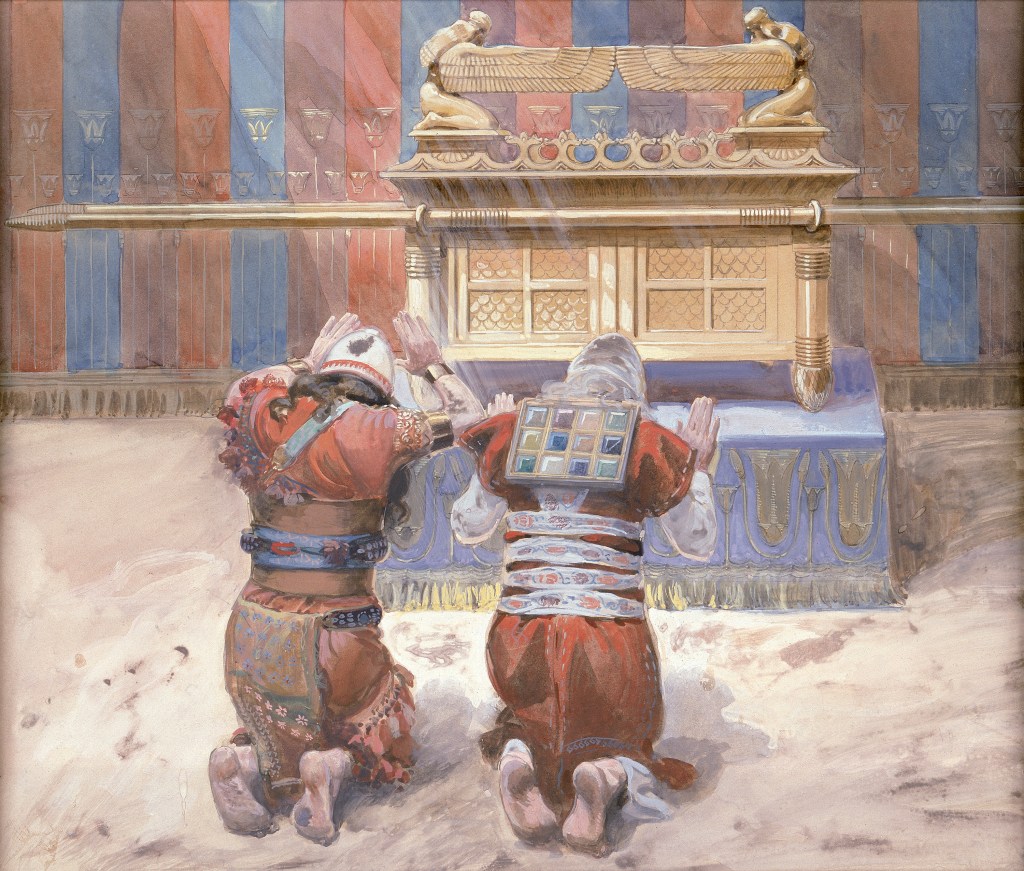
As I’m sure you noticed, these quotes speak of Mary with the utmost honor. You may also recall that the artwork I used for this post is a painting of Moses and Joshua bowing before the Ark of the Covenant. The first Ark was venerated more than any other object on earth, and yet this was in no way considered idolatrous.
Then Joshua tore his clothes, and fell to the earth upon his face before the Ark of the Lord until the evening, he and the elders of Israel; and they put dust upon their heads.
This passage seems to describe not just bowing, but prostration, fully laying face down on the ground, which is an even greater act of veneration than bowing. If the original Ark was so highly venerated, how much more should we be venerating the True Ark, the Mother of God, who carried Our Lord inside of her very body? The Ark was the most holy and sacred object in creation at the time, so it follows that the true Ark would be even more holy and even more sacred — this is how typology works, the fulfillment of the type always exceeds the original significantly.
In themselves, the Ark was simply a container, and Mary is simply a woman. But God elevated both Mary and the Ark far above the typical container and the typical woman — both of them were created for extremely sacred purposes, which made them extremely sacred. The inner room of the Tabernacle, and eventually the Temple, where the Ark was kept, was referred to as “the Holy of Holies” — which essentially means “the holiest of all holy things”, clearly indicating how Israel viewed the Ark. Realize too that the Ark wasn’t just venerated when God was overshadowing it, but all the time, meaning that they weren’t just venerating God who happened to be with the Ark at the time, but they were indeed venerating the Ark itself — not because of what it was in itself, but because of what God had made it to be. And this is exactly why we venerate Mary and the Saints: not because of what they are in themselves, but because of what God has made them to be. Therefore, veneration of the Ark was ultimately veneration of God, and veneration of Mary and the Saints is ultimately veneration of God.
We need Mary like the Israelites needed the Ark — not because God somehow isn’t enough on His own, but because this is how God has decided to accomplish His will. God didn’t need to give the Israelites the Ark to lead them to the promised land, but He did; likewise, God didn’t need to give us Mary to lead us to Heaven, but He did — Our Blessed Mother is a gift to us from God which we do not deserve, and for which we should never stop thanking Him. Mary leads us by example, she is the prototypical Christian, our ideal. She shows us how to follow Christ perfectly, and she reveals to us what awaits us if we persist until the end: an embodied life of endless joy in Heaven for eternity.
Conclusion
As I alluded to at the beginning of this post, Mary being the True Ark actually relates directly to each of the Marian dogmas that we’re going to discuss in future posts: the Immaculate Conception, the Perpetual Virginity, and the Bodily Assumption into Heaven. All of our beliefs about Mary are not only interconnected with each other, but with everything that we believe about Christ. And the evidence for all of these beliefs permeates the biblical texts — Mary is like a thread woven throughout the pages of Scripture, as I’ve hopefully demonstrated well here. You have to look at several different passages and see how they all interconnect with one another to form the full picture, which you can’t see by just looking at them in isolation.
This is partly why Protestants have so much trouble understanding these doctrines, because they tend to want a single clear and straightforward statement to back up every Christian belief, but that’s simply not how Scripture works. To quote Frank Sheed in the introduction to his book Knowing God: “Scripture is no more a manual of theology than of science.” The purpose of these texts was never to be a manual of theology, or a list of doctrines, or a Catechism, or anything of that sort. Rather, the Bible is a library of texts which tell the epic story of man’s relationship with God. So expecting it to be a clear and complete account of Christian doctrine is simply wrong. (For more on how Protestants misunderstand and misuse the Bible, check out my post What the Bible is Not, Part II: Protestant Misconceptions)
If you’ve made it all the way through this post, I want to thank you sincerely for giving me the opportunity to share all of this with you. I hope that you’ve learned a few helpful things, and that above all you’ve gained even just a bit more appreciation for Our Blessed Mother, and a bit more insight into how sacred and special she is. This is still only the beginning of our Marian journey though, so there will be much more to come, and with each new topic that we cover you’ll see more and more clearly how deep our faith is, and how awesome Our Mother is.
God love you.
 Via Logos Agape