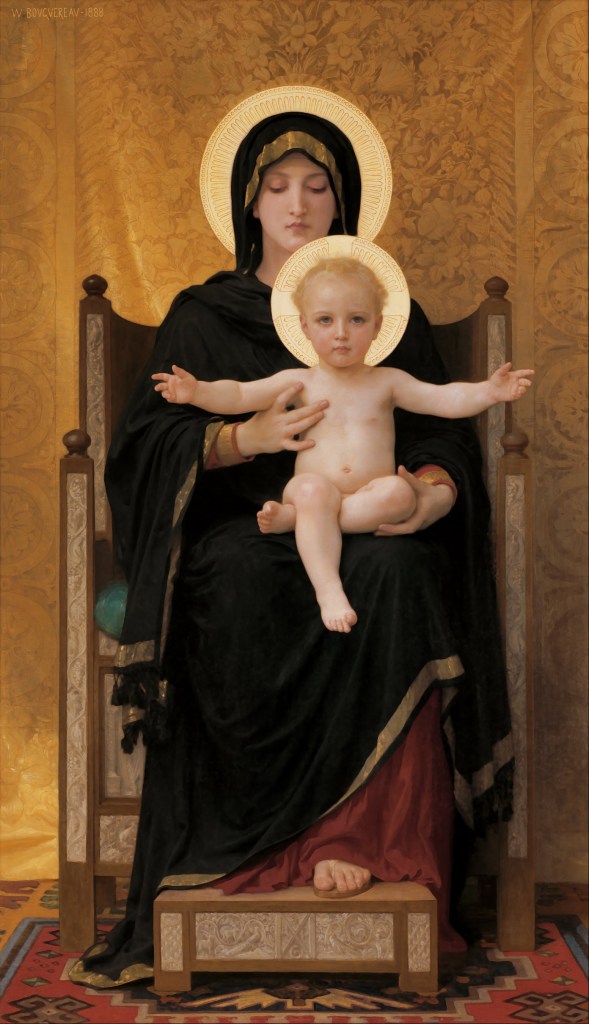
“Him Whom the heavens cannot contain, the womb of one woman bore.
She ruled our Ruler; she carried Him in Whom we all are; she gave milk to our Bread.”
– Saint Augustine of Hippo, ‘Sermons on the Liturgical Seasons’, Sermon 184 (c. 400 A.D.)
For quite a while now, I’ve felt a strong desire to write about the Blessed Virgin Mary. I was initially drawn back to the Church by the profound truth that I discovered within it, but what began as a mere intellectual pursuit quickly developed into something more akin to a love affair. While I’ve certainly continued to find more and more truth within Catholicism, the astounding beauty that I’ve also found within it has played a key role in helping me fall so deeply in love with it — and Mary is the pinnacle of that beauty.
I’m certain that to some of you it may seem blasphemous for me to say such a thing, but let me explain what I mean. God is the source of all beauty — indeed, He is Beauty, itself — and Mary, a mere creature, is of herself nothing in comparison to God, as are we all. Nevertheless, God manifests His beauty through His creation; every single thing that exists reflects His divine beauty in some manner and measure. And God has manifested His beauty in and through Mary more than anywhere else in His entire creation.
If God is an artist, Our Lady is His greatest masterpiece.
Not everyone sees it, though. In my experience, many non-Catholics are confused by the devotion that Catholics have to Mary, and some are quite scandalized by it. Even some Catholics worry about over-glorifying Mary, or simply feel indifferent towards her, failing to see what all the fuss is about. But whether we’re talking about Catholics or non-Catholics, an aversion or indifference to Marian devotion most often stems from a lack of understanding, which is something that can be remedied through education. If a person understands who Mary truly is, and what precisely makes her so special, then the veneration given to her will make perfect sense.
Therefore, I’m endeavoring to publish a series of posts — of which this will be the first — geared towards helping you gain a deeper understanding of Mary’s utterly unique position within creation, by explaining and discussing her various titles and roles, and helping you to see more clearly the incredible beauty that God radiates through her. It is my hope that learning about Mary will give you a greater appreciation for her, and ultimately help you grow closer to her and become more devoted to her, regardless of what you currently believe about Mary or what sort of relationship you have (or don’t have) with her.
Today we will begin this series with what is Mary’s most fundamental title, and her most awe-inspiring role: the Mother of God. To quote Saint John Henry Cardinal Newman, “This is a title which, of all others, we should have thought it impossible for any creature to possess.” And yet it really happened; the God of the universe, in His infinite humility and love, chose to take on the fragile form of a human child, and to submit Himself to the care of a young woman; He entrusted His wellbeing — His very life — to one of His own creations, allowing her to be His mother. Like many Christian truths, we could spend forever contemplating this beautiful mystery, and I hope that after reading this post you do take the time to reflect on some of the ideas I’m presenting here; pray about them; ask God (and Mary, if you’re comfortable with it) to help you understand these truths more deeply.
Now, the official, dogmatic title that the Church gives to Mary is actually not “Mother of God” but “Theotokos” — and a bit further down I’ll explain why this is significant. But this Greek word, Theotokos, has been used as a title for Mary since at least the third century. It’s a composit of two terms: “Theos” which means God, and “tokos” which means childbearing or childbirth. So, a close English paraphrase of Theotokos would be she who bore God in her womb or she who gave birth to God, but it is more literally translated as God-bearer. In the West it has become more common nowadays to simply call Mary “the Mother of God”, while the Eastern churches still typically use the term Theotokos, but they can be used interchangeably as they mean the same thing when properly understood.
On that note, I do want to take a moment to clarify what precisely we mean when we call Mary the Mother of God — and what we don’t mean. There are two operative terms in this title which must be defined, “Mother” and “God”, because each of these can be a source of misunderstanding.
What We Mean By “God”
Firstly, by “God” we are referring exclusively to Jesus Christ, the human Incarnation of the Divine Logos, the second Person of the Holy Trinity, also referred to as the Son. The Christian God is trinitarian, meaning that in the one God there are three Persons: the Father, the Son, and the Holy Spirit. Each of these Persons is fully and equally Divine — meaning fully and equally God — so while we can call the whole Trinity “God”, we can also rightly call each individual member of the Trinity “God”. Trinitarian theology can be quite challenging, so don’t worry if you have a hard time making sense of it; the important thing to understand for now is that there’s nothing wrong or misleading about referring to Jesus as “God”.
So, Mary is not the mother of God the Father — she is His daughter, as every Christian is His child. Nor is she the mother of the Holy Spirit — she is His spouse, because it was Him by whom she conceived Christ. She is only the mother of Jesus Christ, the Logos, because He alone took on the form of man in the Incarnation. Already, we can begin to see Mary’s totally unique relationship to God: no one else in history has been the mother of God the Son, or the spouse of the Holy Spirit, two more facts which merit contemplation.
As a quick aside, it will be helpful to mention here that these relational terms — father, child, spouse, etc. — are to some degree symbolic when we use them in regards to God. For example, Mary is Jesus’s mother, but God the Father is both Mary’s Father and Jesus’s Father, which would be problematic if we took all of these terms strictly literally. And if the Holy Spirit conceived Jesus with Mary, why doesn’t Jesus call the Holy Spirit His father? All of this only makes sense if you recognize that we’re speaking analogously when we use these terms in reference to God, which is to say that we’re using them to mean something similar to what these terms typically mean, but not exactly the same.
God the Father is our father, not in exactly the same way that our human fathers are our fathers, but in a similar way — though an even higher, more profound way. Just the same, Mary is the spouse of the Holy Spirit, not in exactly the same way that a human husband and wife are spouses, but in a similar way — an even higher, more profound way. The language we use to refer to God will always be analogous, describing an even higher reality than what the terms typically represent, simply because He is so utterly unlike anything else in reality; He so transcends our world that none of our words, concepts, or categories can fully apply to or describe Him (more on this topic in a future post).
Alright, back to the main discussion.
What We Mean By “Mother”
When we call Mary the Mother of God, we do not mean that Mary pre-existed God/the Logos, as parents typically do their children, or that she brought God/the Logos into existence; this would be nonsense, since God is eternal, which means that nothing pre-existed Him and nothing brought Him into existence. Furthermore, Mary is a mere creature, a finite human being like you or me — she was created by God, not vice versa. Yet we also don’t mean that Mary was a mere surrogate for a child not her own, tasked with raising, nurturing, and loving Christ from His infancy as His “adoptive” mother while having no biological relation to Him.
Instead, when we say “Mother”, we mean that Mary bore in her womb and gave birth to God in His human Incarnation, Jesus Christ. Not only that, but she provided the genetic material — her DNA, her own flesh and blood — of which Christ’s human body was made, as all biological mothers do. So, Mary was a true, biological mother to Jesus Christ, who is God. She was not the source of His divine nature, yet the Person whom she formed in her womb and gave birth to was both fully divine and fully human — fully God and fully man.
Think of it this way: no human mother brings into existence her child’s soul — the soul is always created ex nihilo (“out of nothing”) by God, Himself — but this takes nothing away from her true motherhood. The same is true for Mary, only in her case God provided not just the soul, but the divinity of Jesus Christ, a characteristic which no other human has shared. Still, Mary herself contributed no less to the existence of Jesus Christ than any other human mother contributes to the existence of her child.
Importantly, if Mary had not been a true, biological mother to Jesus Christ, He would not have been a descendent of King David through Mary’s lineage, which was necessary in order to legitimatize His claim to David’s throne, and to fulfill the prophecy of the Messiah descending from the Davidic line. Even the New Testament recognizes the importance of this:
Paul, a servant of Jesus Christ, called to be an apostle, set apart for the gospel of God which he promised beforehand through his prophets in the holy scriptures, the gospel concerning his Son, who was descended from David according to the flesh…
(Paul’s Epistle to the Romans, 1:1-3)
Even more significantly, though, is that Christ would not have been fully human had He not been the true, biological offspring of Mary, in part because He wouldn’t have been a descendent of Adam, the first man, and being descended from Adam is a key feature of humanity. Much more could be discussed on this topic (and I’ll likely write a post about it in the future), but the main point right now is that when we call Mary the “Mother” of God, we mean that she is truly, literally, and biologically the mother of Jesus Christ.
And yet, importantly, the Church does not call Mary “Mother of Christ” but rather “Mother of God” — not “Christ-bearer” but “God-bearer”. Why is this? Even if you accept that Jesus Christ is God Incarnate, that He is the Logos made flesh, you may still think that it would be easier, wiser even, to call Mary “Mother of Christ” — not as a denial of His Divinity, but as a clarification of what we’re really saying about Mary (or what we’re not saying), since all three Persons of the Trinity can be called “God” both individually and collectively. So why not avoid the potential confusion and simply refer to Mary as “Mother of Christ” rather than “Mother of God”?
For very good reason, actually.
A Right Christology
There are four infallibly-defined teachings about the Blessed Virgin Mary, referred to as the Marian Dogmas, and Mary’s title of Theotokos is one of these dogmas. A dogma is the highest and most authoritative category of teaching in the Catholic Church — it is a doctrine that is essential to Christianity.
The dogma which declares Mary to be the Mother of God was infallibly defined at the Council of Ephesus in the 5th century. Saint Cyril of Alexandria proposed twelve anathemas which were officially accepted by the Council, and the one regarding Mary’s Divine Motherhood was the very first of the twelve. It reads:
“If anyone does not confess that Emmanuel is God in truth, and therefore that the Holy Virgin is the Mother of God [Theotokos] (for she bore in a fleshly way the Word of God become flesh) let him be anathema.”
“Anathema” essentially means “excommunicated” — it means that anyone who rejects the teaching in question is rejecting an essential aspect of the faith that Christ has given us, and is therefore rejecting Christ, which places the person outside of Christ’s Church. Dogmas like this cannot be denied without denying some core aspect of the deposit of faith given to us by Jesus Christ, which has been safeguarded and passed down to us through His Church. This is why Church councils say “let him be anathema” when infallibly defining these teachings.
If you’re wondering why any teaching about Mary would be necessary to our faith, the above quote from the Council of Ephesus should give you a hint: this teaching that Mary is the Mother of God is essential not because of what it says about Mary, but because of what it says about Christ. We give the name Christology to the science of understanding Jesus Christ — of conceptualizing who and what He is. It is absolutely essential for us to have an accurate Christology, because if we get Christ wrong, we will inevitably get Christianity wrong. But in order to get Christ right, we must also get Mary right, which means that an accurate Mariology is just as essential as an accurate Christology, since the two are so intertwined.
So, while Mary’s Divine Motherhood indeed makes her incomprehensibly special and worthy of the utmost veneration, it’s not because of who she is in and of herself, but because of who she is in relation to God. In other words: Mary did nothing to merit being chosen to be the Mother of God, because she was chosen for this role before she even existed — God created her specifically to be His mother. And all of Mary’s beauty, all of her virtue, all of her magnificence, is merely a reflection of God’s. An oft-used symbol for Mary is the moon, because while the moon is the brightest and most beautiful light in the night sky, in truth it emits no light of its own, but rather reflects the light of the sun. Just the same, everything wonderful about Mary is a reflection of the “light” of her Son.
With that in mind, we can better understand why it is important for Mary to have the title “Mother of God” rather than “Mother of Christ”. It is because this title — Mother of God — contains a theological truth about Christ that is integral to our faith; namely, that He is simultaneously fully man and fully God, and these two natures — human nature and divine nature — are perfectly and totally united in Him from the moment of His conception. And that last part is why it’s significant that the Church’s official dogmatic title for Mary is “God-bearer” rather than “Mother of God”, because calling her “God-bearer” emphasizes the fact that Christ was God even in utero — Mary truly bore God in her womb — meaning He was not born human and then became divine at some later point, as certain heretics in the early Church proposed. The truth about Christ’s dual natures wasn’t always accurately understood; like many doctrines, it took time for the Church to work out how to properly express the reality of the Incarnation. But eventually, through the guidance of the Holy Spirit, the Church developed language to accurately describe Christ and the Incarnation without error.
The term which the Church developed in order to describe this union between Christ’s human and divine natures is the Hypostatic Union. This concept tells us that the human Jesus and the divine Logos are not two different beings, or two different people joined together; nor did the Logos merely use a human body as a vessel, or take the place of a human soul within the body of Jesus, because this would mean that God did not fully become human. Instead, the Hypostatic Union means that the Logos, the Word of God, totally united to Himself a full human nature — a human body and a human soul — and thereby entered into our human existence as the God-Man Jesus Christ. Like the Trinity, this is a great mystery, how God could become man and yet remain God. But as difficult as it may be to fully understand, there is still a correct way to conceive of it, as well as many incorrect ways. And in the early Church, several incorrect ways of conceiving of the Incarnation were put forth and eventually condemned.
Nestorianism
At the time when the Council of Ephesus was called, a heresy had developed regarding how to understand the bond between the divinity and the humanity of Christ. The bishop of Constantinople at the time, Nestorius, was by most accounts a devout Christian who opposed heresy where he found it and seemed to have a genuine desire to promulgate truth. Nevertheless, he fell into error when, in late A.D. 428, he preached the first of his several infamous sermons against the word Theotokos. He denied that the Blessed Virgin Mary could rightly be called the mother of the Logos because “No one can bring forth a son older than herself.”
This, of course, was a misunderstanding on the part of Nestorius; as I explained earlier, calling Mary the Mother of God does not mean that she is the source of Christ’s divinity. So, in part because of this misunderstanding, Nestorius claimed that Mary was only the mother of Christ’s human nature, not the mother of His divine nature. Sadly, it’s common today to see this same heresy asserted by Protestants as an attempt to oppose Catholic Marian doctrine and devotion. The problem is that this objection implies a denial of the Hypostatic Union — it separates Christ’s human nature from His divine nature, when in reality they were perfectly united from His conception. It also simply doesn’t make sense, since mothers are not mothers of natures, but of persons; you wouldn’t say of your mother: “She is the mother of my human nature.” She is your mother, and you are a person, not a nature. The same is true for Jesus; calling Mary “the mother of Christ’s human nature” is nonsense — Mary is the mother of the Person Jesus Christ, whom she conceived, carried in her womb, gave birth to, then raised and nurtured throughout His entire life. And if this Person whom she mothered was, indeed, God, then we can and should call her the Mother of God — the God-bearer.
So, Nestorius’s teaching was immediately opposed by his peers, and for the next few years there were several back-and-forth arguments between himself and various bishops as they attempted to correct his error. But he was stubborn, and eventually the Council of Ephesus was called, where his teaching would be officially and infallibly condemned. You can read more about Nestorius and his heresy here, and you can find all of the documents associated with the Council of Ephesus here if you’re interested in reading more about it. Honestly, it’s difficult to say whether Nestorius’s misunderstanding was truly theological or merely semantic, and it seems that if only he had properly understood the terminology and what the title “God-bearer” actually meant, he may very well have changed his mind about it. To quote Jimmy Akin, from his book ‘The Fathers Know Best’:
Ironically, it appears that Nestorius expressed himself badly and was not guilty of the heresy that bears his name. After he was deposed, he dwelled in a monastery in El-Kharga, Egypt, maintaining his orthodoxy. He died in communion with the Church.
(Chapter 12, ‘Nestorianism’)
Regardless, through the Council of Ephesus the Church definitively asserted that when the terminology and the theology are properly understood, there is no falsehood in calling Mary the Mother of God, or God-bearer, and indeed this title is not only fitting, but is Traditional and Apostolic, having been in use since the earliest days of the Church. You don’t have to take my word for it, though — let’s look at some excerpts from the writings of the Church Fathers.
What The Fathers Say
“The Virgin Mary, being obedient to his word, received from an angel the glad tidings that she would bear God.”
— Saint Irenaeus of Lyons, ‘Against Heresies’ 5:19:1 (c. A.D. 189)
“For Luke, in the inspired Gospel narratives, delivers a testimony not to Joseph only, but also to Mary the Mother of God, and gives this account with reference to the very family and house of David.”
— Saint Gregory Thaumaturgus, ‘Four Homilies’ 1 (c. A.D. 256)
“While [Simeon] was thus exultant, and rejoicing with exceeding great and holy joy, what had before been spoken of in a figure by the prophet Isaiah, the holy Mother of God now manifestly fulfilled.”
[. . .]
“Hail to you forever, you Virgin Mother of God, our unceasing joy, for unto you do I again return. . . . Hail, you fount of the Son’s love for man. . . . Therefore we pray you, the most excellent among women, who boast in the confidence of your maternal honors, unceasingly to keep us in remembrance. O holy Mother of God, remember us, I say, who make our boast in you, and who in august hymns celebrate your memory, which will ever live, and never fade away.”
— Saint Methodius of Philippi, ‘Oration on Simeon and Anna’ VII, XIV (c. A.D. 300)
“[T]hey came to the church of the most blessed Mother of God, and Ever-Virgin Mary, which, as we began to say, he had constructed in the western quarter, in a suburb, for a cemetery of the martyrs.”
— Saint Peter of Alexandria, ‘The Genuine Acts of Peter of Alexandria’ (A.D. 305)
“Many, my beloved, are the true testimonies concerning Christ. The Father bears witness from heaven of His Son; the Holy Ghost bears witness, descending bodily in likeness of a dove; the Archangel Gabriel bears witness, bringing good tidings to Mary; the Virgin Mother of God bears witness; the blessed place of the manger bears witness.”
— Saint Cyril of Jerusalem, ‘Catechetical Lectures’ 10:19 (c. A.D. 350)
“It was for our sake that Christ became man, taking flesh from the Virgin Mary, Theotokos.”
– Saint Athanasius of Alexandria, ‘Against the Arians’ 3.29 (c. A.D. 360)
“The first thing that kindles ardor in learning is the greatness of the teacher. What is greater than the Mother of God? What more glorious than she whom Glory itself chose?”
— Saint Ambrose of Milan, ‘Concerning Virginity’ 2:2:7 (A.D. 377)
“If anyone does not believe that Holy Mary is the Mother of God, he is severed from the Godhead.
If anyone should assert that He passed through the Virgin as through a channel, and was not at once divinely and humanly formed in her, he is in like manner godless.
If any assert that the Manhood was formed and afterward was clothed with the Godhead, he too is to be condemned.
[…]
If any introduce the notion of Two Sons, one of God the Father, the other of the Mother, and discredits the Unity and Identity, may he lose his part in the adoption promised to those who believe aright. For God and Man are two natures, as also soul and body are; but there are not two Sons or two Gods.
[…]
For both natures are one by the combination, the Deity being made Man, and the Manhood deified…”
— Saint Gregory of Nazianz, ‘Letter to Cledonius the Priest’ 101 (A.D. 382)
“Do not marvel at the novelty of the thing, if a Virgin gives birth to God.”
— Saint Jerome, ‘Commentaries on Isaiah’ 3:7:15 (c. A.D. 409)
“And so you say, O heretic, whoever you may be, who deny that God was born of the Virgin, that Mary the Mother of our Lord Jesus Christ ought not to be called Theotokos, that is, Mother of God, but Christotokos, that is, only the Mother of Christ, not of God. For no one, you say, brings forth what is anterior in time. And of this utterly foolish argument by which you think that the birth of God can be understood by carnal minds, and fancy that the mystery of his majesty can be accounted for by human reasoning, we will, if God permits, say something later on. In the meanwhile we will now prove by divine testimonies that Christ is God, and that Mary is the Mother of God.”
— Saint John Cassian, ‘On The Incarnation’ (Against Nestorius) 2:2 (c. A.D. 429)
“Nestorius, whose disease is of an opposite kind, while pretending that he holds two distinct substances in Christ, brings in of a sudden two Persons, and with unheard of wickedness would have two sons of God, two Christs — one God, the other man; one begotten of his Father, the other born of his Mother. For which reason he maintains that Saint Mary ought to be called not Theotokos [the Mother of God], but Christotokos [the Mother of Christ], seeing that she gave birth not to the Christ who is God, but to the Christ who is man.”
— Saint Vincent of Lerins, ‘Commonitorium’ 12:35 (c. A.D. 434)
As you can see, the Fathers give overwhelming testimony to the fact that Mary is rightly called the Mother of God theologically-speaking, and that this title for her has been in use since the earliest days of the Church.
Also very much worth mentioning here is an ancient Marian prayer — that is, a prayer to Mary — which dates back at least to the mid 200s, titled “Sub tuum praesidium” which means “Beneath Thy Protection”. This short prayer demonstrates not only the early use of the title Theotokos, but the early practice of Marian prayer and veneration. Here is the text of the prayer:
We fly to thy protection,
O Holy Mother of God [Theotokos];
Do not despise our petitions
in our time of need,
but deliver us always
from all dangers,
O Glorious and Blessed Virgin
You may be wondering, though, what does Scripture itself have to say on the matter? Testimony from the early Church is important, but many Protestants disregard the Church Fathers and care only about what’s written in the Bible. And of course, Scriptural testimony is very important for Catholics, as well. So, can we find evidence of Mary’s divine motherhood in the Bible?
Absolutely.
What Scripture Says
There are three biblical texts that we’ll look at which provide the clearest testimony to Mary’s divine motherhood. The first is at the very beginning of the New Testament, in the first chapter of the Gospel of Saint Matthew:
“Behold, a virgin shall conceive and bear a son,
— Matthew 1:23
and his name shall be called Emmanuel” (which means, God with us).
Here, Matthew is quoting the Messianic prophecy in Isaiah 7:14 and applying it to Mary. Now, if Emmanuel means “God with us” and this virgin, Mary, will bear Emmanuel, then it follows that Mary will/did bear God. So, we could rightly call Mary “God-bearer” — Theotokos — based solely on this single verse from Scripture.
The second passage we’ll look at which testifies to Mary’s divine motherhood does so in even more explicit terms.
In the first chapter of the Gospel of Saint Luke, we see Mary going to visit her cousin Elizabeth; and in verse 43, Elizabeth refers to Mary as “the mother of my Lord” — which is substantially the same as calling her “the mother of God“, because the Israelites often referred to God as “Lord”. This can be seen throughout both the Old and the New Testaments (God is called “Lord” over one thousand times in the Old Testament), but most importantly it can be seen in the surrounding context of this first chapter of Luke’s Gospel. In fact, the word “Lord” appears fifteen other times in Luke 1 (in verses 6, 9, 11, 15, 17, 25, 28, 32, 38, 45, 46, 58, 66, 68, 76) and every single time, it refers to God. Not only that, but Elizabeth herself uses the word again in that very same interaction with Mary, and she clearly uses it to refer to God. Here’s the context:
“And why is this granted me, that the mother of my Lord should come to me? For behold, when the voice of your greeting came to my ears, the babe in my womb leaped for joy. And blessed is she who believed that there would be a fulfilment of what was spoken to her from the Lord.”
— Luke 1:43-45
Even in the original Greek, Elizabeth uses the exact same word for “Lord” both times: “kuriou“. And if you wanted to try to claim that when she said “mother of my Lord” she was somehow not using it to mean “God”, but rather only referring to Christ in His human nature, not in His divine nature, you’d be committing the Nestorian heresy which we covered earlier, separating Christ’s divinity from His humanity. So, there’s really no way around it — Sacred Scripture, through quoting Elizabeth, refers to Mary as “the mother of God”.
There’s something else I want to point out about this passage, though, which relates more broadly to Marian devotion. Protestants often criticize Catholics for focusing too much on Mary, asserting that we should only — or at least primarily — be focusing on Christ at all times. Yet when we read about this interaction between Elizabeth and Mary in Luke 1, there’s something significant which I think most of us tend not to notice. Elizabeth is in the direct, physical presence of God, and she knows it, yet what is her primary focus? Mary. Let’s look at the fuller context of the passage:
And when Elizabeth heard the greeting of Mary, the babe leaped in her womb; and Elizabeth was filled with the Holy Spirit and she exclaimed with a loud cry, “Blessed are you among women, and blessed is the fruit of your womb! And why is this granted me, that the mother of my Lord should come to me? For behold, when the voice of your greeting came to my ears, the babe in my womb leaped for joy. And blessed is she who believed that there would be a fulfilment of what was spoken to her from the Lord.”
— Luke 1:41-45
Look at what’s happening here. Elizabeth is inspired by the Holy Spirit to praise and venerate Mary, despite the fact that Jesus is right there with Mary, in her womb, and Elizabeth is fully aware (because she was just “filled with the Holy Spirit”) that Jesus is God. I don’t think you could get a clearer or stronger endorsement of Marian devotion and veneration than this, that the Holy Spirit Himself inspired it in Elizabeth, in the very presence of God. This is another profound truth to reflect on and pray with. (This passage has another layer of significance, as it parallels an Old Testament passage related to the Ark of the Covenant, but we’ll wait and cover that in an upcoming post in this Marian series.)
Alright, the final Scripture passage we’ll look at is less explicit about Mary’s divine motherhood, but still very significant. It’s taken from one of my favorite passages in Scripture, and one which I’ve referenced on this blog before: the prologue to Saint John’s Gospel.
“In the beginning was the Word, and the Word was with God, and the Word was God.
And the Word became flesh, and dwelt among us…”
– The Gospel of Saint John, 1:1,14
There’s something here that is so simple and yet so profound — God became flesh. He did not “inhabit” flesh, He did not use flesh as a vessel, He became flesh. This confirms what I mentioned earlier: the Logos did not “inhabit” the man Jesus, He did not “possess” the man Jesus or use Jesus as a vessel; rather, the Logos became the man Jesus, the Word of God became a human being. This affirms the Church’s teaching on the Hypostatic Union, and puts to rest any notion that Jesus was not both fully human and fully divine.
Furthermore, based on Scripture alone, we can assert the following logical syllogisms:
- Premise 1: The Word is God.
- Premise 2: Jesus is the Word.
- Conclusion: Therefore, Jesus is God.
- Premise 1: Mary is the mother of Jesus.
- Premise 2: Jesus is God.
- Conclusion: Therefore, Mary is the mother of God.
Because these are valid logical arguments (the conclusions necessarily follows from the premises), it means that in order to deny the conclusions you must deny one of the premises. So, in order to deny that Mary is the mother of God, you either have to deny (1) That the Word is God, (2) That Jesus is the Word, or (3) that Mary is Jesus’s mother — there’s no other way around it. And because Scripture explicitly affirms each of these points, it means that to deny that Mary is the mother of God is to deny Scripture.
At this point, after all that we’ve discussed here, I don’t know how much more thoroughly I could have proven the truth and the orthodoxy of calling Mary the God-bearer and/or the Mother of God. So, hopefully, if you came into this discussion with doubts about it, your doubts have been sufficiently answered. If not, feel free as always to email me through my Contact page with any questions, comments, or counter-arguments.
There is a bit more that I want to discuss here, though, related to Mary’s divine motherhood and the practical implications it has — implications which hold great significance for all Christians.
One Flesh
In my post on Purgatory, I touched on the fact that as Christians we become members of Christ’s body in a very real way. This is made explicit many times throughout the New Testament. Here are just a few examples:
The body is not meant for immorality, but for the Lord, and the Lord for the body.
Do you not know that your bodies are members of Christ? Shall I therefore take the members of Christ and make them members of a prostitute? Never! Do you not know that he who joins himself to a prostitute becomes one body with her? For, as it is written, “The two shall become one.” But he who is united to the Lord becomes one with him in Spirit.”
— 1 Corinthians 6:13,15-17
“For as in one body we have many members, and all the members do not have the same function, so we, though many, are one body in Christ, and individually members one of another.”
— Romans 12:4-5
“He [Christ] is the head of the body, the Church”
— Colossians 1:18
“For the husband is the head of the wife as Christ is the head of the church, his body, and is himself its Savior.
Even so, husbands should love their wives as their own bodies. He who loves his wife loves himself. For no man ever hates his own flesh, but nourishes and cherishes it, as Christ does the Church, because we are members of his body. “For this reason a man shall leave his father and mother and be joined to his wife, and the two shall become one flesh.” [Genesis 2:24] This is a great mystery, and I mean in reference to Christ and the Church;”
— Ephesians 5:23, 28-32
Note that the last passage references the book of Genesis, where God tells Adam and Eve that through their marital union a man and a wife become one flesh. This same language is what is being used to describe the Church as Christ’s body (see also 2 Corinthians 11:2). And all of this language is obviously not mere symbolism, since Saint Paul even says at the end of the quote that “This is a great mystery” how Christ and the Church are one flesh — if it were merely symbolic, there would be nothing mysterious about it. The Ignatius Catholic Study Bible comments similarly regarding all of this language about the Church being the body of Christ: “This is not simply a metaphor for the Church, with the focus on her organizational unity, but it expresses the metaphysical reality that every believer is truly united with Christ by the Sacraments. The Spirit is the soul of this mystical body, giving life, growth, and direction to each of its members.” (Commentary on 1 Corinthians 12:13, p. 303)
What does it mean that “every believer is truly united with Christ by the Sacraments“?
To put it simply: in the Sacrament of Baptism, we are made members of Christ’s body; then, this fleshly bond is constantly renewed, increased, and strengthened through reception of the Sacrament of the Eucharist — consuming the literal Body, Blood, Soul, and Divinity of our resurrected and glorified Lord Jesus Christ.
“For just as the body is one and has many members, and all the members of the body, though many, are one body, so it is with Christ. For by one Spirit we were all baptized into one body—Jews or Greeks, slaves or free—and all were made to drink of one Spirit.
Now you [the Church] are the body of Christ, and individually members of it.”
— 1 Corinthians 12:12-13, 27
“The cup of blessing which we bless, is it not a participation in the blood of Christ?
— 1 Corinthians 10:16-17
The bread which we break, is it not a participation in the body of Christ?
Because there is one bread, we who are many are one body, for we all partake of the one bread.”
Now, profound as this all may be, you’re likely wondering how exactly all of this relates to Mary and her divine motherhood.
Since, as we have established, Christ took His flesh from Mary, it means that Christ and Mary are quite literally “one flesh”. Yet we, too, as I’ve demonstrated using Scripture, become “one flesh” with Christ. It therefore follows that, through our baptism into Christ’s body, we not only become one flesh with Christ, but we also become one flesh with Mary, because they are one flesh. Once again, this is an incredibly profound truth which merits deep contemplation, rather than mere intellectual analysis. But in the hopes of serving our contemplation, let me briefly explain why this makes so much sense — and why it fits so well with the whole of Catholic theology.
Behold Your Mother
When Christ is dying on the Cross — barely able to breathe, let alone speak — and He nevertheless decides to talk, we should take whatever He says as having the utmost importance, or else He surely wouldn’t have gone to the trouble of saying it in such a dire and painful situation.
So, when we read the following in Saint John’s Gospel…
When Jesus saw His mother and the disciple whom He loved standing beside her, He said to His mother,
— John 19:26-27
“Woman, behold, your son.”
Then He said to the disciple, “Behold, your mother.”
And from that hour the disciple took her into his home.
…we shouldn’t assume that this is some minor detail about who would look after Jesus’s mother after His death. For one, Jesus didn’t say “Please look after my mother after I’m gone” — He said “Behold your mother” and “Behold your son”. If you were dying, and you asked your friend to look after your mother once you were gone, would you say to your friend “She’s your mother now” and say to your mother “He’s your son now”? Of course not. Clearly, there’s a deeper significance to Christ’s words here.
Let’s turn again to the Ignatius Catholic Study Bible for some helpful commentary:
John [“the disciple whom He loved”] is not just an individual disciple, he is portrayed by the evangelist as an icon of every disciple whom Jesus loves. In this sense, Mary is given to all beloved disciples of Christ, just as every disciple is given to the maternal care of Mary.
(Commentary on John 19:26, p. 198)
So, when Christ says “Behold your mother”, He is saying it to every single Christian, every “disciple whom He loves”. And when He says “Woman, behold your son”, He is telling Mary that she is now mother to all of us, we are all her sons and daughters. This is, in a way, the culmination of everything we’ve discussed here regarding Mary’s divine motherhood. While being the Theotokos makes her worthy of the highest level of veneration given to anything or anyone except God Himself, it also has very practical implications for each of us: Mary is not just God’s mother, she is our mother too. This makes perfect sense when we understand that, through our baptism and our reception of the Eucharist, we become “one flesh” with Christ, we become members of His body — His body which was literally formed by the Blessed Virgin Mary, composed of her own flesh. He also saw fit to place His body under the care and protection of Mary, so if we are members of His body, we too have been placed under her care and protection by Christ, Himself. And while this truth can be deduced through reading Scripture and logically connecting various dots as I’ve demonstrated here, Jesus also wanted to make it explicit, through the words that Saint John wrote in his Gospel, whereby Christ on the Cross gives His mother to “His beloved disciple” — to you, and to me, and to each and every baptized Christian.
It’s also important to remind ourselves that this isn’t all just abstract theology — Mary is a real person, an actual human being. And whether you realize it or not, if you’re a baptized Christian, you are united with Mary more intimately than with anyone else except God, Himself.
She is your mother, not in exactly the same way that your earthly mother is your mother, but in a similar way — an even higher, more profound way.
How blessed we are to have Mary as our mother! It means that she is constantly praying for us, constantly helping us, constantly nurturing us, constantly loving us, constantly willing our good, in perfect union with her Son in Heaven.
I sincerely hope that what I’ve shared here will be enriching to you, and that it will lead you to greater communion with Our Blessed Mother. Don’t be afraid of growing closer to Mary. Think of it like this: we all know from experience that when you love somebody, you want to get to know them better, and doing so helps you to grow to love them even more. One way you can achieve this is by getting to know their family; when you get to know someone’s family, you are thereby getting to know that person even more deeply. And when you grow to love someone’s family, you’re growing in love for that person, too. So, if you want to get to know Jesus better, if you want to grow in love for Him even more, then get to know His mother, and grow in love for her. Form a relationship with her through prayer. If you’re still uncomfortable with praying directly to Mary, ask Jesus to help you; bring your concerns to Him and ask Him to guide you. I have no doubt that He will guide you to His mother, just as she guides us all to Him.
In closing, I have one more quote to share, a beautiful homily which Saint Cyril proclaimed at the Council of Ephesus:
“I see the assembly of the saints, all zealously gathered together, invited by the holy Mother of God, Mary, ever-virgin . . .
Hail, we say, O holy and mystic Trinity, who have called us together in this church dedicated to Mary, Mother of God.
We hail you, O Mary Mother of God, venerable treasure of the entire world, inextinguishable lamp, crown of virginity, scepter of orthodoxy, imperishable temple, container of Him who cannot be contained . . .
Hail, you who held the Uncontainable One in your holy and virginal womb!
Through you, the Holy Trinity is glorified; the precious cross is celebrated and adored throughout the whole world; Heaven exults, the angels and archangels rejoice, the demons are put to flight, the devil, the tempter, falls from Heaven, the fallen creation is brought back to Paradise, all creatures trapped in idolatry come to know of the truth . . .
What more is there to say? Because of you the light of the only-begotten Son of God has shone upon those who sat in darkness and in the shadow of death; prophets pronounced the word of God; the apostles preached salvation to the Gentiles; the dead are raised to life, and kings rule by the power of the holy Trinity.
Who can put Mary’s high honor into words? She is both mother and virgin. I am overwhelmed by the wonder of this miracle. Of course no one could be prevented from living in the house he had built for himself, yet who would invite mockery by asking his own servant to become his mother?
Behold then the joy of the whole universe. Let the union of God and man in the Son of the Virgin Mary fill us with awe and adoration. Let us fear and worship the undivided Trinity as we sing the praise of the ever-virgin Mary, the holy temple of God, and of God himself, her Son and spotless Bridegroom.
To Him be glory for ever and ever.
Amen.
— Saint Cyril of Alexandria, ‘Theotokos, Cause of Joy for the Whole World’ (A.D. 432)
Blessed Mary,
Mother of God and Mother of all Christians,
Pray for us.
God love you.
 Via Logos Agape
One thought on “Theotókos: The God-Bearer”