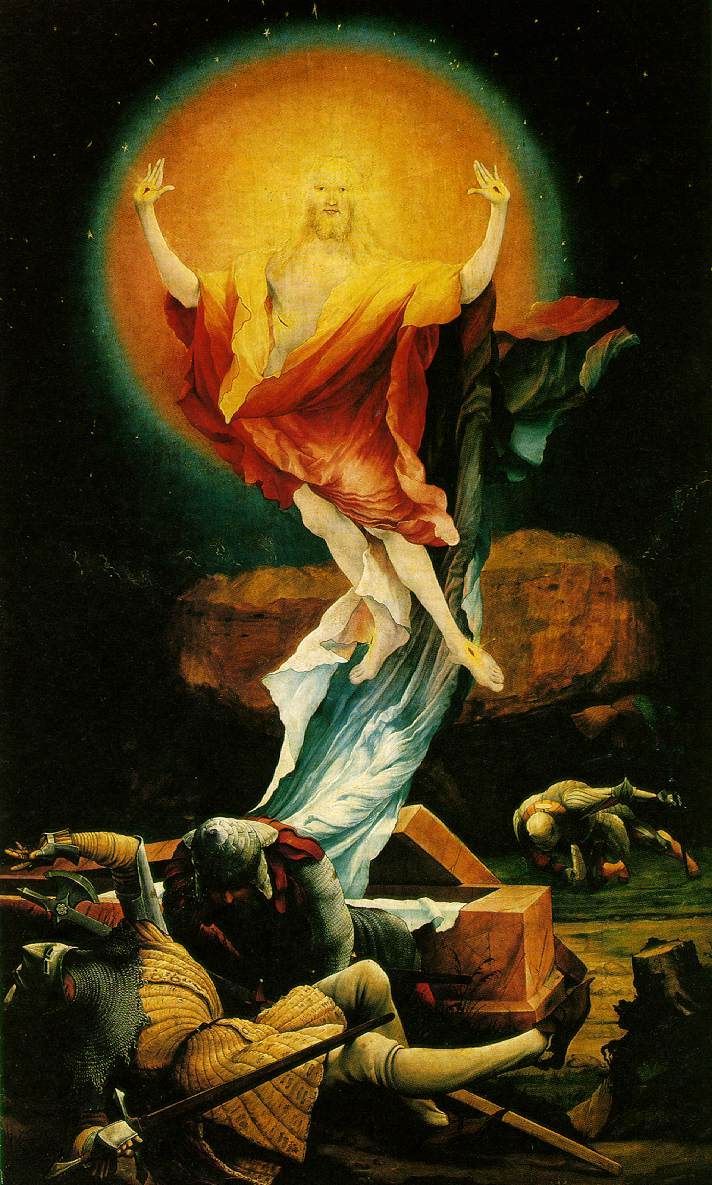
*Note: I originally published this post last year, but as I was preparing to share it again due to Easter coming up, I saw room for improvement, so I decided to create a new, updated version that would be even more helpful and educational. I’ve added lots of hyperlinked sources for various terms and ideas within the post, instead of just having a list of a few sources at the bottom as I did originally, so that you can now see more directly where each bit of information is coming from and read more about these things if you’d like. I also made some edits for clarity, and even added some new information. If you find this post helpful and educational, please do share it. There are some pernicious lies about this holiday that are fairly widely believed, and this post was made precisely to counteract those lies.
“A lie can travel half way around the world while the truth is putting on its shoes.”
― Mark Twain
Easter is the Christian celebration of the Resurrection of Jesus Christ after his Crucifixion and death. But in recent history, claims have begun circulating regarding Easter’s alleged relation to paganism. Some say that Easter was originally a pagan celebration of fertility or new life, which only later developed into the Christian celebration of the Resurrection. Others assert that the Catholic Church and/or emperors of the past deliberately decided to move the celebration of Christ’s Resurrection to around the same time of year as similar pagan celebrations, and to adopt pagan customs related to eggs and rabbits (symbols of fertility), in order to create an easier transition for pagans who were being manipulated and forced into converting to Christianity.
Every single one of these claims is demonstrably false, though, and in this post I’m going to explain exactly how and why they are false.
The Date Of The Resurrection
According to the Gospel accounts, Jesus was crucified at the beginning of the Jewish Passover celebration. Passover is a holiday commemorating the liberation of the Hebrew people from their enslavement in Egypt, which is recounted in the Old Testament book Exodus, and thought to have happened around the 13th century BC. Passover takes place in the month of Nisan on the Hebrew calendar, beginning on the evening of the 14th day of that month (or what we would call the evening of the 13th day, because the Hebrew people measured days from sundown to sundown instead of from midnight to midnight like we do today) and ending on the 21st or 22nd depending on which tradition one holds to. The Gospels recount that Jesus offered the Last Supper “on the first day of unleavened bread (Passover), when they sacrificed the Passover lamb” (Matthew 26:17-29; Mark 14:12-25; Luke 22:7-20). In the year 30 AD — the year of Christ’s Passion (this article gives a detailed explanation for how that date can be determined) — the 14th of Nisan occurred on a Friday, so keeping in mind that the Hebrew people measured days from evening to evening, we can determine that the 14th of Nisan lasted from Thursday evening to Friday evening, meaning the Last Supper happened on Thursday night. This also means that the Last Supper and the Crucifixion (which happened on the following afternoon) occurred in the same calendar day for the Hebrews, on the first day of Passover. This was “the day of preparation”, which was the day before the Sabbath. This is when the Passover lambs were slain and prepared to be eaten during the Passover Seder meal on the Sabbath.
So almost immediately, we can discount the possibility that the core of our Easter celebration developed out of pagan fertility festivals. Christ’s crucifixion, death, and resurrection are purported to be true historical events which took place at a specific time: during the Hebrew Passover celebration in the year 30 AD. And the Passover itself certainly didn’t develop out of pagan fertility celebrations, because we know what it’s about: the Hebrew people’s emancipation from slavery. Importantly, if you were to study the Bible, Christian theology, and typology, you would discover that Easter is linked to the Passover in far deeper and more complex ways than you’d think, to the point where you simply cannot understand the full meaning of Easter if you don’t understand the Passover tradition. Christ being slain on the day of preparation, for instance, when the Passover lambs were slain in preparation to be eaten, is just scratching the surface of the typology surrounding Christ’s Passion. It would take far too long to do justice to this topic here, though, so you’ll have to take my word for it until I publish a post focused solely on this issue (which I plan to do).
Determining The Observance
You may or may not be aware, though, that today we don’t actually celebrate Easter in accordance with the Passover. The dates for these holidays each vary from year to year, independently of each other. Why is this? Was the date for Easter actually moved, as some claim, to overlap pagan fertility celebrations?
In short, no — there isn’t even a shred of truth to this claim.
The Hebrew calendar is a lunisolar calendar, meaning that the dates are determined in part by the phases of the moon, unlike the Gregorian calendar we use today, which determines dates using equinoxes. Because of this, the two calendars don’t line up, and so Passover occurs on different Gregorian dates each year. But this still leaves us with the question: if the Resurrection happened on the third day of Passover, why don’t we celebrate Easter on the third day of Passover each year?
In the first few centuries, the Eastern branch of the Church had made a tradition of continuing to observe the Passover celebration during the same time it had historically been celebrated, but associating this celebration with Christ’s Passion. However, in the Western branch of the Church, the Resurrection had come to be celebrated on the first Sunday after Passover began, regardless of the date, because Sunday was the day of the week on which Jesus rose from the dead. Because their celebrations were on different days, this created a divide in the Church, which led to a series of disputes that came to be known as the Paschal Controversies (see Encyclopedia Britannica, Oxford Reference, and Wikipedia).
The 3rd/4th century historian Eusebius of Caesarea wrote the following in reference to these disagreements:
“A question of no small importance arose at that time [i.e. the time of Pope Victor, about A.D. 190]. The dioceses of all Asia, as from an older tradition, held that the fourteenth day of the moon, on which day the Jews were commanded to sacrifice the lamb, should always be observed as the feast of the life-giving Pasch, contending that the fast ought to end on that day, whatever day of the week it might happen to be.
However it was not the custom of the churches in the rest of the world to end it at this point, as they observed the practice, which from Apostolic tradition has prevailed to the present time, of terminating the fast on no other day than on that of the Resurrection of Our Savior. Synods and assemblies of bishops were held on this account, and all with one consent through mutual correspondence drew up an ecclesiastical decree that the mystery of the Resurrection of the Lord should be celebrated on no other day but the Sunday, and that we should observe the close of the paschal fast on that day only.”
Over time, the Church as a whole increasingly opted for the Sunday celebration, and the Quartodecimans — those who wanted to continue the traditional Passover observance beginning on the 14th of Nisan — remained a minority. Eventually, at the Council of Nicaea in 325 AD, it was decided that the holiday was always to be held on a Sunday, because Sunday was (and still is) considered the Lord’s Day, it being the day of Christ’s Resurrection.
Looking again to Eusebius, we find that the emperor Constantine himself wrote to the churches after the Council of Nicaea, exhorting them to adopt its conclusions. These are Constantine’s words, recorded by Eusebuis:
“At this meeting the question concerning the most holy day of Pascha [Easter] was discussed, and it was resolved by the united judgment of all present, that this feast ought to be kept by all and in every place on one and the same day. For what can be more becoming or honorable to us than that this feast from which we date our hopes of immortality, should be observed unfailingly by all alike, according to one ascertained order and arrangement? And first of all, it appeared an unworthy thing that in the celebration of this most holy feast we should follow the practice of the Jews, who have impiously defiled their hands with enormous sin, and are, therefore, deservedly afflicted with blindness of soul. For we have it in our power, if we abandon their custom, to prolong the due observance of this ordinance to future ages, by a truer order, which we have preserved from the very day of the Passion until the present time.”
— Life of Constantine, Book III, Chapter 18
The overarching goal of the Council of Nicaea was to settle any disputes in the Church so that Christians would be united under common practices, and it was for this reason that the Council decreed that Easter should be observed on the same day by the whole Church. As should be clear now, there were several factors that informed the final decision on when Easter should be observed — the day of the week on which Christ rose from the dead, the Apostolic tradition, and a desire to move away from the practices of the Jewish people (because Jews were often persecutors of Christians in the early Church) — and none of these factors had anything to do with paganism.
Even after this decision by the Council, there arose further difficulties over determining on which particular Sunday Easter should be observed, thanks in part to the evolution of dating methods and switching between calendars (Hebrew/Julian/Gregorian). The goal became to maintain, for each Easter Sunday, the same season of the year and the same relationship to the preceding astronomical full moon that occurred at the time of Christ’s Resurrection in 30 AD. Due to all of the complexities, the matter actually wasn’t fully resolved until the 16th century by Pope Gregory the 13th (after whom our Gregorian calendar is named) and his astronomers and mathematicians. The method they finally devised is what we still use today, and now Easter can fall on any Sunday between March 22 and April 25.
Hopefully all of this makes it abundantly clear that the timing of the Easter celebration was not in any way determined or influenced by pagan practices.
What’s in a Name?
But what about the word “Easter” itself? Some like to claim that the term comes from the name of a pagan fertility goddess — either Ishtar or Eostre, depending on who you ask. And as you can see, the word “Easter” does seem like it could potentially share etymological roots with one of these words — but does it?
The claimed Easter/Ishtar connection is quite a recent theory, promulgated by a man named Alexander Hislop, a 19th century Protestant minister, who also happened to be a strident anti-Catholic conspiracy theorist. Hislop is most known for his book titled The Two Babylons; Or, The Papal Worship Proved to be The Worship of Nimrod and His Wife.
According to Wikipedia:
“In the book, Hislop argued that the Catholic Church was a Babylonian mystery cult and pagan, but that Protestants worshiped the true Jesus and the true God. He believed that Roman Catholic religious practices are pagan practices that were grafted onto true Christianity during the reign of Constantine.”
These ideas may sound familiar to many of you, because unfortunately it’s a belief still commonly held today among some Protestants and non-Christians — that the Roman Emperor Constantine created the Catholic Church by fusing together Christianity with Roman paganism. As you can see, though, this idea was popularized by an anti-Catholic conspiracy theorist just a couple of hundred years ago, which doesn’t lend much credence to the theory.
Don’t take my word for it that Hislop is unreliable, though. Here are some highlights from his Wikipedia pages:
- “No claim made by Hislop has been confirmed by historians.”
- “…the Greek authors whom he quoted lacked credibility…”
- “…there have been many who have challenged the accuracy of Hislop’s claims.”
- “Lester L. Grabbe (an historian of ancient Judaism) has highlighted the fact that Hislop’s entire argument … is based on a misunderstanding of historical Babylon and its religion”
- “Grabbe also criticizes Hislop for portraying the mythological queen Semiramis as Nimrod’s consort, despite the fact that she is never even mentioned in a single text associated with him, and for portraying her as the “mother of harlots”, even though this is not how she is depicted in any of the texts where she is mentioned”
- “…commentators have made the assertion that the document (Two Babylons) contains numerous misconceptions, fabrications, logical fallacies, unsubstantiated conspiracy theories, and grave factual errors.”
I could go on, but you get the picture.
So the next time you hear someone claim that the Catholic Church is pagan, or that it was created by Constantine, just remember that the source of these claims is the man and the book being described by the above quotes.
Regarding the Easter/Ishtar connection, let me quote Hislop himself:
“Easter is nothing else than Astarte, one of the titles of Beltis, the queen of heaven, whose name, as pronounced by the people Nineveh, was evidently identical with that now in common use in this country. That name, as found by Layard on the Assyrian monuments, is Ishtar.”
That was his entire argument: the words “Easter” and “Ishtar” sound the same when you say them, therefore they are referring to the same goddess.
Not very convincing if you’re familiar with the concept of homophones. But it’s even less convincing when you understand etymology, for as the Wikipedia page goes on to say, “Modern etymologists derive the word Easter from the Proto-Indo-European root aus-, meaning ‘dawn’, [while] Ishtar is a Semitic name of uncertain etymology, possibly taken from the same root as ‘Assyria’, or from a semitic word meaning “to irrigate”.
In other words, there is no actual connection between Easter and Ishtar, etymologically or otherwise. So consider that theory debunked.
But what about the other name I referenced?
Easter and Eostre
The name “Eostre” comes from the Proto-Indo-European root “aus-” meaning “dawn”, “to shine”, and “the east” (since the sun rises in the east) — which you may recall I just mentioned above in regards to the etymology of the word “Easter”. That’s right, the word Eostre shares the same etymological root as the word Easter — now we’re getting somewhere!
The idea that Eostre was the name of a goddess actually has its origin in the writings of a Benedictine monk named Saint Bede the Venerable, who was a theologian, historian, and chronologist, around the beginning of the 8th century. His treatise on chronology, De temporum ratione (“On the Reckoning of Time”), written in the year 725, was mainly concerned with the reckoning of Easter, and there is but a single passage in it that references Eostre:
“In olden time, the English people — for it did not seem fitting to me that I should speak of other people’s observance of the year and yet be silent about my own nation’s — calculated their months according to the course of the moon. Hence, after the manner of the Greeks and the Romans, (the months) take their name from the Moon, for the Moon is called ‘mona‘ and the month ‘monath‘.
The first month, which the Latins call January, is Giuli; February is called Solmonath; March Hrethmonath; *April, Eosturmonath*; May, Thrimilchi; June, Litha; July, also Litha; August, Weodmonath; September, Halegmonath; October, Winterfilleth; November, Blodmonath; December, Giuli, the same name by which January is called. …
Eosturmonath has a name which is now translated “Paschal month”, and which was once called after a goddess of theirs named Eostre, in whose honour feasts were celebrated in that month. Now they designate that Paschal season by her name, calling the joys of the new rite by the time-honoured name of the old observance.”
— ‘De ratione temporum’ 15. The reckoning of time, tr. Faith Wallis, Liverpool University Press 1988, pp.53-54
So, Saint Bede claims that the Anglo-Saxons who converted to Christianity carried over some of their own customs into their new faith. Specifically, they kept using the names that they had given to the months, which were originally derived from the names of their gods (just as most of ours still are, today). This meant that they called the Paschal season — the season of the Crucifixion and Resurrection — ‘Eostermonath’, because that was the name of the month in which it took place. The conversion of the Saxons in England from their original Germanic religion to Christianity occurred in the 7th century, so Saint Bede, who was himself English, was writing about something which had happened quite recently, and in his own home country, which lends credence to his claims.
One point against the theory that Eostre was the name of a goddess, though, is that Saint Bede is actually the only historical source we have that even mentions her, so some historians doubt whether Bede’s information on this topic is accurate. Personally, it seems more logical to me that Bede is correct than that he’s mistaken, but the fact is that it doesn’t actually matter. I’ll explain why in just a moment, but first, let’s assume that Bede is correct, and that Eostre was a goddess, after whom a month was named, and that the Christian celebration of Christ’s Resurrection in England was referred to using the word for this month, “Eosturmonath”, because this was when it took place. Would this mean that our celebration of Easter is thereby related to or developed out of paganism? Of course not.
For a modern comparison, think about how we in the U.S. call Independence Day “The Fourth of July”. The month of July is named after Julius Caesar. So arguing that Easter is associated with the pagan goddess Eostre is like arguing that the Fourth of July is associated with Julius Caesar. Or another example, Juneteenth, which is the celebration of the emancipation of the last of the slaves in the United States. But did you know that June is named after Juno, the Roman goddess of childbirth and fertility? That’s right, a pagan fertility goddess! So I guess that must mean Juneteenth is actually a pagan holiday, right? I mean, it’s right there in the name, so Juneteenth clearly developed out of pagan fertility celebrations.
If you think this is a bad argument (and you should, because it is), understand that this is the same argument people are making about Easter being associated with the goddess Eostre.
I certainly don’t mean to mock anyone who has been duped by these conspiracy theories — but I absolutely mean to mock the theories, themselves, because they’re so ridiculous and easy to disprove. Unfortunately, you aren’t going to recognize how nonsensical they are if you don’t know the history, and the vast majority of us don’t. When we hear a claim enough times, and the claim sounds like it could be true easily enough, and the people making the claim sound like they know what they’re talking about, then we’re often going to just take their word for it — especially if we have biases that the claim confirms or supports, like biases against the Catholic Church, or against all of Christianity, or against religion in general.
Lost (And Found) In Translation
Back to the etymology of “Easter”, though. Recently, scholars have actually come to believe that the word “Easter” has no relation whatsoever to any pagan gods or goddesses — not even incidentally. From the Encyclopedia Britannica entry on Easter:
There is now widespread consensus that the word derives from the Christian designation of Easter week as “in albis”, a Latin phrase that was understood as the plural of alba (“dawn”) and became “Eostarum” in Old High German, the precursor of the modern German and English term.
So, the Latin “in albis” (“white garments”) was used by Latin Christians to describe Easter week, which according to the Catholic Encyclopedia came from “the white garments which the newly baptized assumed on Holy Saturday [the day before Easter], and wore until Low Sunday [the first Sunday after Easter] which was consequently known as dominica in albis (deponendis), the Sunday of the (laying aside of the) white garments.” This Latin term “albis” could mean either “white” or “dawn”, and it was understood by Germans as being a plural form of “alba” which they took to mean “dawn”, so when they translated it into their own language they used the Proto-Germanic plural term for “dawn”, which was “austrǭ” (remember how I mentioned above that the root “aus-“ means “dawn”?), which then became the Old High German “ōstarūn” or “eostarum”, which became the Middle High German “ōsteren”, which became the modern German “Ostern” — from which we derive the English word “Easter”.
What this means is that it is very likely that our word “Easter” has no connection whatsoever to any pagan deities, but instead derives originally from the Latin term for Easter week (“in albis”) being slightly mistranslated from “white” in Latin to “dawn” in Proto-German, then translated to Old High German, then to Middle High German, then to modern German and English.
But remember, even if Saint Bede is right about Eostre being the name of a month which was named after a pagan goddess, this would still make the connection between the name “Easter” and paganism accidental — and therefore irrelevant.
It’s also helpful to know that, unlike English, most other languages derive their word for Easter from the word Pascha, a Greek term which comes from Pasha, the Aramaic form of the Hebrew word Pesach, which means “Passover”. Still today, the true name for the Easter celebration according to the Church is “Pascha” — it is only called “Easter” in areas where English is the native language. The Romance languages, on the other hand, have adopted the Hebrew-Greek term, and so in their languages they refer to Easter as follows: Latin, Pascha; Italian, Pasqua; Spanish, Pascua; French, Paeques. Some Celtic and Teutonic nations also use it: Scotch, Pask; Dutch, Paschen; Danish, Paaske; Swedish, Pask.
What this tells us is that any possible pagan connections that the word “Easter” is thought to hold would still have no bearing whatsoever on the original meaning of this holiday, because this holiday wasn’t called “Easter” until hundreds of years after its inception, and is still only called such by a minority of Christian peoples and cultures.
I hope you’ve found all of this information interesting and educational. I know that I went a bit into the academic weeds in this section, perhaps giving you more detail than you expected, but I wanted to make it abundantly clear that no matter how deep you dig, you will not find any meaningful connection between the word “Easter” and any pagan goddess — and even if you did, it would have no bearing on the origin of the holiday.
Bunnies and Eggs
Alright, so the date of Easter is not deliberately associated with any pagan customs, nor is the name, but what about the traditions? What do the Easter Bunny, painting eggs, and baskets of candy have to do with the Resurrection of Christ? Clearly these strange practices must be carryovers from the pagan world, yes?
No, actually.
As far as the eggs and the baskets of candy go, these traditions are thought to have come about due to the period of fasting that takes place during Lent, the (roughly) forty days which lead up to the celebration of the Resurrection. Today, most people — Christian or not — are aware of the “no meat on Fridays” Lenten practice. But the customs have changed a bit over the centuries, and back in the Middle Ages the restrictions during the Lenten fast were greater than they are today. As Saint Gregory writing to Saint Augustine of England in the 6th century said, “We abstain from flesh meat, and from all things that come from flesh, as milk, cheese, and eggs.”
This prohibition of eggs during Lent led to the development of the popular custom of blessing, painting, and making gifts of eggs at Easter. The emptied egg shells also symbolized the empty tomb of Jesus after his Resurrection, and another ancient tradition involved specifically painting eggs red “in memory of the blood of Christ, shed as at that time of his crucifixion.” The baskets of candy come from the feasting that happened once the Lenten fast was over, and the English custom of eating pancakes on Shrove Tuesday (known more popularly today as “Fat Tuesday”) developed from people wanting to use up the last of their milk and eggs the day before the Lenten fast began.
Okay, but what about the Easter Bunny? Surely this one has to be a pagan fertility symbol, right?
Wrong again!
The Easter Bunny actually originated with German Lutherans, and the first mention of the tradition is found in Georg Franck von Franckenau‘s ‘De ovis paschalibus‘ (‘About Easter Eggs’) in the year 1682. The “Easter Hare” originally played the role of a judge, evaluating whether children were good or bad (much like Santa Claus) at the start of the Easter season. But why a hare? Likely because Easter takes place in the spring, and rabbits have always been associated with spring because that’s when they’re most active. Yet even if you wanted to speculate that this Easter Hare myth probably developed out of older German pagan beliefs associated with rabbits and fertility, it would mean that the integration of (allegedly) pagan traditions into Easter happened very recently, around the 17th century, making it irrelevant to our discussion here. We’re trying to determine whether Easter developed out of paganism, not whether pagan practices have come to be associated with Easter centuries after its origin.
As an interesting aside, though, the association of rabbits with Christianity actually goes back much further than the 17th century. The hare was a popular motif in medieval church art. Why? In ancient times it was widely believed that the hare was a hermaphrodite, and this idea that a hare could reproduce without loss of virginity led to an association with none other than the Blessed Virgin Mary, with hares sometimes appearing in illuminated manuscripts and Northern European paintings of the Virgin and Christ Child. On top of that, it may also have been associated with the Blessed Trinity, as in the Three Hares Motif.
And just in case you’re still clinging to the idea that the Easter Bunny could be a pagan symbol related to the goddess Eostre, The Oxford Dictionary of English Folklore states unequivocally that “there is no shred of evidence” that hares were sacred to Eostre, because Saint Bede — the one and only reference we have to Eostre — does not associate her with any animal.
Christian To The Core
So there you have it. Our celebration of Easter has absolutely nothing to do with pagan gods, pagan holidays, pagan rituals, etc. Easter is a distinctly Christian holiday, and has been since the very beginning.
I hope you’ve learned a few things from this discussion, whether you’re Christian or not. I also hope that what I’ve said here will cause some of you to reevaluate what you think you know about the history of the Church, especially if you were one of the many people who believed the “Easter is pagan” claim. Our modern secular culture is extremely hostile to religion in general, but Christianity specifically (and Catholicism even more specifically), and there are far more lies and misconceptions floating around out there than you’d think. So, if you’re not a fan of Christianity in general or Catholicism specifically, I’d encourage you to reconsider your preconceptions, and maybe do a bit more research. After all, if you were mislead about this, imagine how much else you may have been mislead about?
I also hope you keep reading this blog, because I definitely plan on busting more of these kinds of myths (as I’ve done here with Halloween). But above all, I’m going to do my best to show you just how profoundly beautiful the Catholic faith is — and how true, of course.
God love you.
 Via Logos Agape
One thought on “Is Easter Pagan?”