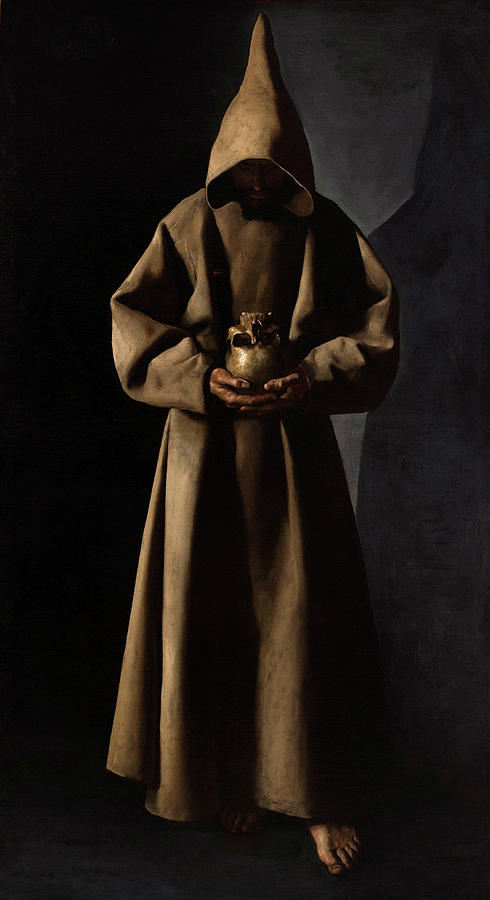
I love this time of year, in large part because of the cooler weather and the beautiful changes happening in nature, but also because the reality of death is more manifest than ever. As the leaves change color and fall to the ground, we’re reminded that everything living will one day die, which makes it the perfect time of year to practice Memento Mori — meditating on the reality of death — and to memorialize those who have died already.
Yet something I don’t particularly appreciate about the Halloween season is the fact that so many people spread myths and misconceptions about its origins. Much like Easter and Christmas, it is often claimed that Halloween has “pagan roots”, and many Christians are against celebrating Halloween because they think it has connections to paganism or Satanism or black magic.
In reality, this couldn’t be further from the truth, so I’d like to set the record straight on the history of Halloween. Because I ended up finding so much information on this topic, I’m dividing the discussion into two parts. Here in Part I, I’ll focus on debunking one of the most common myths about Halloween’s origin. Then in Part II, I’ll share the true history of this holiday and of the modern customs associated with it. I’m sure you’ll learn quite a lot — as I did while doing the research — and I hope you find the topic as interesting as I have.
Samhain
Possibly the most common lie that’s spread about Halloween is that it developed out of an alleged Celtic pagan festival known as Samhain (pronounced ‘sah-win’, and sometimes spelled ‘Samuin’ or ‘Samain’). But misconceptions abound regarding the nature and origin of Samhain, to the point where virtually everything that people today believe about it is a complete fabrication.
The only historical sources we have that mention Samhain are medieval Irish Christian folk stories. This is because the Irish have no written records prior to the beginning of their Christianization in the 4th or 5th century — which is a significant point, because it means that nothing can be said with any real confidence about the possible ancient pagan beliefs and practices of the Celtic people.
Therefore, we should think of these medieval folk stories as similar to our modern genre of historical fantasy. Many centuries after the Christianisation of Ireland, writers were simply imagining what the ancient Celtic culture may have been like, and often taking plenty of artistic liberty in their portrayals. Their ideas were likely influenced by various sources, ranging from Classical literature such as Virgil’s Aeneid, to the Bible itself, to Norse paganism, which Irish authors came into contact with through Viking raiding and settlement in Ireland. The point, though, is that these stories are not reliable accounts of history, and we in fact have no such accounts from ancient Ireland because, as I said, they kept no such records.
But what do these medieval folk stories say about Samhain?
“The Wooing of Emer”
The very earliest record of Samhain comes from a tale of Irish mythology called Tochmarc Emire (“The Wooing of Emer”). The oldest partial manuscript we possess of the story is from the 15th or 16th century A.D., though 19th century German scholar Kuno Meyer, who specialized in the field of Celtic philology and literature, believed the story itself was likely first written in the 10th century.
Here is the first excerpt:
“Bend Suain, son of Rosc Mele, which she said this is the same thing, viz., that I shall fight without harm to myself from Samuin, i.e., the end of summer. For two divisions were formerly on the year, viz., summer from Beltaine (the first of May), and winter from Samuin to Beltaine.”
After this first mention, the term is used just once more in the text:
“They went to the house of Ruad, King of the Isles, on Samuin night.”
Here is the source of the English translation I’m using for these quotes.
As you can see, in each instance the term is simply used to refer to a time of year — not a holiday or festival. This makes sense, because the word Samhain or Samuin literally just means “Summer’s end” and, as was described in the first excerpt above, the ancient Celts evidently divided their year into just two seasons: Summer, which lasted from Beltaine (May 1st) to Samuine (November 1st), and Winter, which lasted from Samuine to Beltaine. It is thought by some scholars that Samhain may have marked the beginning of the Celtic new year, similar to our observance of New Year’s Day on January 1st; but how the ancient Celts may have celebrated such a day, if at all, is not something we have record of.
“The Book of Invasions”
Another of the earliest sources we have that mentions Samhain is Lebor Gabála Érenn (“The Book of Invasions”). Written in the late 11th century, this book is a collection of mythological poems and prose narratives intended to be a history of Ireland and the Irish people from the creation of the world to the Middle Ages. But modern scholars regard the Lebor Gabála as primarily myth rather than history, at least until it reaches the early medieval period. It was inspired by other medieval Christian pseudo-histories, as well as the Biblical story of the Exodus. Scholars believe its writers may have intended to create an epic origin story for the Irish like that of the Israelites, one which reconciled native myth with the Christian view of history.
In one part of the story, a people called the Nemedians (named for their leader, Nemed) settle in Ireland and do battle with a race of monsters called Fomorians. But after Nemed and many others die of a plague, the Nemedians are then oppressed by two Fomorians named Conand and Morc, and every Samhain (before Winter begins) they must give them two thirds of their children, their wheat, and their milk. And that’s all it says about it. So another of our earliest sources on Samhain says absolutely nothing about it being a pagan festival.
“The Intoxication of the Ulstermen”
The third and final text we’ll look at is a comedy narrative called Mesca Ulad (“The Intoxication of the Ulstermen”), which has been dated to the late 12th century. The story is set during Samhain, and follows the Ulstermen as they attempt to attend two feasts in two different towns in the same night. The men become intoxicated at the first feast, and some hijinks ensue. But although the story takes place on Samhain night, Samhain is only mentioned once in the story. Here’s the quote:
A year was the province thus, in three divisions, until the feast of Samain was made by Conchobar in Emain Macha. The extent of the banquet was a hundred vats of every kind of ale. Conchobar’s officers said that all the nobles of Ulster would not be too many to partake of the banquet, because of its excellence.
Here is a link to the full English translation of the story.
Just for some context: Ulster was a province in north-eastern Ireland in the Middle Ages, and Conchobar was the fictional king of Ulster in Irish mythology, who ruled from Emain Macha. The story explains that Ulster was divided into three sections due to quarreling between certain groups, and so the king instituted a grand banquet to be held on Samhain in an effort to unite the divided province. Once more, we see no pagan rituals associated with Samhain.
Bad Scholarship
The truth is that virtually all modern practices relating to Samhain are recent developments popularized by Neo-Pagans, a movement which originated in 19th century Romanticism. But if our earliest records on Samhain don’t mention any relation to paganism, and if indeed we don’t actually know what the ancient Irish pagans may have believed or what rituals they may have practiced, then where do all of these false ideas about Samhain and its alleged connection to Halloween come from? The short answer: historical speculation, and bad scholarship.
One example of the latter is Jean Markale, a writer who has published several books on Celtic civilization and pre-Christian spirituality. His work is cited as a source for many of the modern claims made about Samhain. For example, History.com cites his work ‘The Pagan Mysteries of Halloween’ in their article on Samhain, and based on the few other references they cite it can be assumed that they got the bulk of their information from his book. So why is this problematic?
Here are a few excerpts from his Wikipedia page:
While Markale presents himself as widely read on the subjects about which he writes, the value of his work is controversial. His ‘creative’ use of scholarship and his tendency to make great leaps in reasoning cause scholars following more normative and conservative methods to balk, and his interest in subjects that his critics consider questionable, including various branches of the occult, have gained him at least as many detractors as admirers.
His already weakened reputation was further tarnished in 1989, when he became involved in a plagiarism case after he published under his own name a serious and well-documented guide to the oddities and antiquities of Brittany, the text of which had already been published, twenty years before by a different writer, through the very same publisher.
The Breton scholar Christian-Joseph Guyonvarc’h dismissed Markale as follows: “Mr Jean Bertrand, a.k.a. Jean Markale, styles himself as a professor of classical literature. He never says where he teaches; but […] he cannot properly accentuate Greek, knows nothing of Latin […] he doesn’t know how many cases there are in Irish declension (sometimes he says two, at other times three) […] Jean Markale very complacently quotes his own works in his later publications and, every time an Irish text is mentioned, he refers the reader to his ‘Celtic Epics’ as though that book included actual translations or constituted the most basic and essential reference on the matter. All this is, at best, a joke.”
The History.com article on Samhain also cites the work of Lisa Morton, a screenwriter and horror author, who describes herself as a “Halloween expert” despite having no formal education of any kind listed on her own website or her Wikipedia page.
And it’s not just this one article on History.com that’s problematic; the Wikipedia page for Samhain cites a Time magazine article as one of its sources, and the Time magazine article cites the History.com article I’ve been discussing as one of its sources. This is unfortunately quite common online; people make claims and cite an article, which cites another article, which cites an article or a book written by some unreliable individual whose claims we have no reason to take seriously, and so you end up with these webs of misinformation that people begin to accept as factual. I strongly suggest that everyone take the information on Wikipedia and most other websites with a large grain of salt, and that you do take the time to actually check the sources they cite.
“The Golden Bough“
Another example of bad scholarship is a book titled “The Golden Bough”, written by the Scottish anthropologist Sir James George Frazer, published in 1890. Although it’s only about 130 years old, this book appears to be one of the earliest and most influential sources for the “Halloween is pagan” idea — which shows just how novel this myth is. In the book, Frazer makes massive leaps in logic in order to connect Halloween with Samhain — and indeed all of Christianity to paganism — and his description of Samhain anachronistically projects medieval traditions onto the past. As a result, he has received some harsh criticism for his dishonest and unscientific scholarship.
As Cambridge historian Mary Beard has written, “a large proportion of The Golden Bough is inadequate, as well as irrelevant and monstrously prolix by any reasonable standards of accuracy.” Anthropologist Godfrey Lienhardt notes that even during Frazer’s lifetime, social anthropologists “had for the most part distanced themselves from his theories and opinions”. Another anthropologist, Robert Ackerman, writes that, for British social anthropologists, Frazer is still “an embarrassment”.
Timothy Larsen, a PhD historian and a fellow of the Royal Historical Society, likewise criticizes Frazer for applying western European Christian ideas, theology, and terminology to non-Christian cultures, which as a result distorted and misrepresented those cultures. Larsen concludes that Frazer’s goal in comparing Judeo-Christian beliefs and practices to the beliefs and practices of ancient pagan cultures was not to make the ancient cultures seem less strange, but rather to make Christianity seem more strange and barbaric. And in his book The Slain God: Anthropologists & the Christian Faith, Larsen discusses the irony of The Golden Bough — the fact that its theory has been staunchly rejected by scholars, yet embraced by the public. He says:
“[Frazer’s] work is generally, if not universally, dismissed today by anthropologists, but they are nonetheless saddled with the reality that The Golden Bough is the most popular and influential book in the history of the discipline in terms of its wider cultural impact.”
Frazer’s discussion of Halloween in The Golden Bough is wrapped within his larger theory about the evolutionary progression of human society from a world of magic, to a world of religion, to (finally) a world of science. Sir Edmund Leach, who was “one of the most impatient critics of Frazer’s overblown prose and literary embellishment of his sources for dramatic effect”, gave a scathing critique of the artistic license exercised by Frazer in The Golden Bough, saying:
Frazer used his ethnographic evidence, which he culled from here, there and everywhere, to illustrate propositions which he had arrived at in advance [. . .]
to a degree which is often quite startling, whenever the evidence did not fit he simply altered the evidence!
And quoting again from Godfrey Lienhardt:
The central theme (or, as he thought, theory) of The Golden Bough — that all mankind had evolved intellectually and psychologically from a superstitious belief in magicians, through a superstitious belief in priests and gods, to enlightened belief in scientists — had little or no relevance [to reality], and the whole, supposedly scientific, basis of Frazer’s anthropology was seen as a misapplication of Darwin’s theory of biological evolution to human history and psychology.
Frazer himself even admitted that his theories were speculative, and that the associations he made were circumstantial and usually based only on resemblance. He wrote: “Books like mine, merely speculation, will be superseded sooner or later (the sooner the better for the sake of truth) by better induction based on fuller knowledge.”
However, this doesn’t excuse him from spreading so much false information — much of which was driven by an anti-Christian bias. Here’s an excerpt from a blog post by historian Beth Allison Barr:
Frazer’s anthropological arguments, including those about Hallowe’en, had a clear agenda: to undermine religious belief. As [Timothy] Larsen writes: “Frazer frequently made statements to the effect that anthropology was a reformer’s science — that the material he was presenting should prompt people to seek actively to discard those parts of their thinking and culture that he had exposed as arising from faulty logic.”
So, reading The Golden Bough should inspire Christians to abandon faith and replace it with science. Why? Because religion inspires violence. “Fundamental to Frazer’s work,” continues Larsen, “is the conviction that the reason why some of the foundational timbers of culture are rotten is because they are soaked in blood. Frazer [. . .] viewed religion as inherently drawn to violence; and he viewed such violence as typified by a universal impulse in the religious frame of mind toward human sacrifice. The Golden Bough is relentless in this regard. Frazer argues that the Jewish Passover was really a ritual of human sacrifice: the use of a lamb is a modified survival of something much more awful. It is a sly substitution which dupes ‘the bloodthirsty but nearsighted deity’.
Frazer believed that this taste for blood and sacrifice, encouraged by modern religions which he speculated had been shaped by pagan beliefs, is so strong that it must be intentionally cut away, saying: “Religion will not just naturally die on the vine: it must be purposefully rooted out.” So as you might guess at this point, it’s not just the history of Halloween that The Golden Bough has distorted in the perception of much of the modern world, but the history of the entire Christian religion. Cambridge historian Philip Jenkins has written about the impact of The Golden Bough:
“Still more damaging were claims that key beliefs of Christianity paralleled or plagiarized the common myths of the Middle East, especially those of a dying and rising god. If you follow the comments sections on religious blogs today, it is amazing to see how many commentators still recycle these hoary and long-discredited arguments of early twentieth century Rationalism.
Sir James Frazer’s Golden Bough has a lot to answer for.”
In any case, the bottom line for us here is that there is no legitimate historical evidence that Samhain was originally the kind of pagan festival that it’s often claimed today to have been, or that it has any connection whatsoever to Halloween.
Take it from Ronald Hutton, an English historian who specializes in pre-Christian religion and Contemporary Paganism, who asserts that we have “no idea” what ancient Celts may or may not have believed about Samhain. As he says in his book Stations of the Sun:
The medieval records furnish no evidence that 1 November was a major pan-Celtic festival, and no evidence of religious ceremonies, even where it was observed.
So from now on, anytime you see someone make claims about specific ancient Celtic pagan beliefs or practices — relating to Halloween or not — feel free to swiftly disregard their claims; they’re simply repeating the same all-too-common myths and lies that have been propagated over the last few centuries.
 Via Logos Agape
2 thoughts on “Is Halloween Pagan? (Part I)”