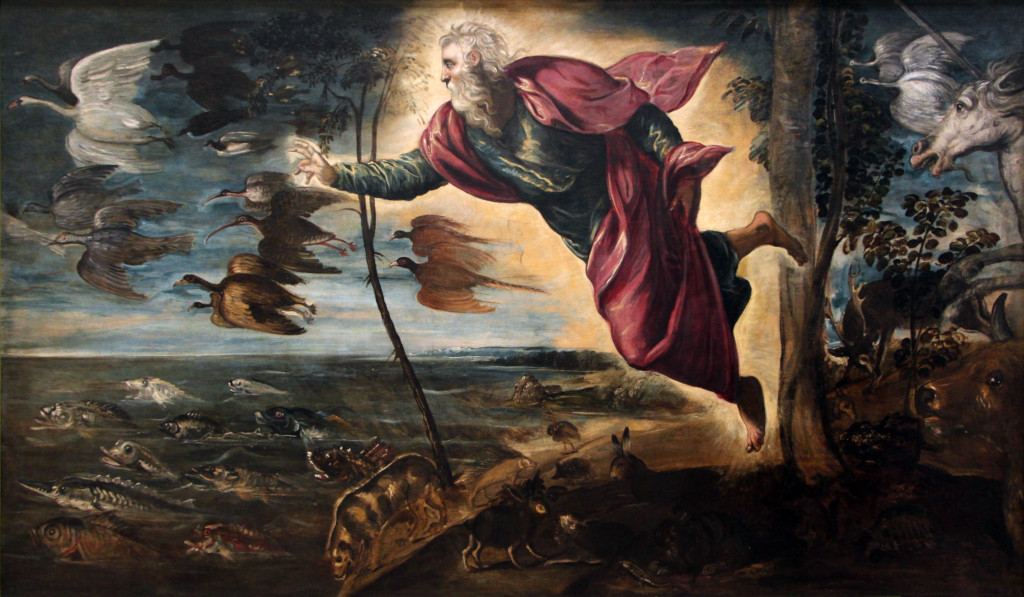
Misconceptions about the Bible are quite common today. From what I’ve seen, most non-Christians seriously misunderstand what the Bible is — but the same can also be said for many Christians. Because of this, I thought it would be helpful to have a discussion about what the Bible is not, so that we can then more clearly see what the Bible is.
This post will be focusing on some common secular misconceptions, and Part II will cover the most prevalent Protestant misconceptions; but I hope that regardless of what you believe, you’ll learn something valuable from both of these discussions.
Alright, let’s talk about what the Bible is not.
A Single Book Or Genre
The word “Bible” is derived from the Greek expression “Ta Biblia” (“The Books”) which came into use in the early centuries of Christianity to designate the whole collection of sacred texts. We see the root biblio- in our English word ‘bibliography’, and in the word for ‘library’ in other languages — Spanish & Italian: biblioteca; German: bibliothek; French: bibliothèque; etc.
And that’s exactly what the Bible is: a library of various texts, from various authors, from various times, written in various languages, in various genres, for various audiences, for various purposes. Which is why Saint Jerome — who, in the fourth century, translated all of the Scriptures into Latin, the common language of the Roman Empire — referred to the Bible as Bibliotheca Divina, which is Latin for “The Divine Library”.
This means that the Bible should not be read as either a history textbook or a mythological story (or any other single genre) any more than the full collection of books at your local library would be. I see this mistake so often from atheists, who claim that the Bible as a whole is a mythological or fictional story (myth and fiction are not the same thing, by the way; more on that in a moment), and for a while I thought the same thing; but this actually shows great ignorance of the Bible, and of the concept of literary genre. Yet I also see this same mistake made by many Christians, who read the entire Bible as though it is a history textbook. I really wonder how many of the atheists who think that the Bible is all myth actually used to be the Christians who think that it’s all history, and they simply went from one extreme to the other.
In reality, Scripture is far more nuanced than that. There are 73 separate books within the Bible, which were written over the course of one to two thousand years. These books contain narrative stories, poetry, wisdom literature, songs, prophecy, prayers, legal codes, biographies, epistles (letters), and more.
Some of it is meant to be an account of actual events, some of it isn’t, and some of it is a mix of legend and history. It was common practice in ancient cultures to convey information through stories, parables, poetry and mythology, so when these people were making records of their history, it wasn’t done in the way that we do it today. For one, much of their history was passed down orally for generations before it was written down, and they were far less concerned with getting all of the details right, because the details weren’t the most important thing — the message was. You can imagine that if stories had to be recited by memory, you’d want to make them as easy to remember as possible, even if that meant summarizing, altering, or omitting some of the less important information.
It must be understood, though, that everything written in the Bible is held by the Church to be true — even the “non-historical” parts. What this means is that the things written about in Scripture point to realities even when the things written about are not realities, in themselves. The authors were always writing about real things — about true things — but these things were described using a variety of different literary styles and devices.
Here’s an insightful quotation from historian and apologist Dr. David Anders on the Genesis creation account:
“To get too hung-up on things like “How many years ago did Adam live?” and “Did Adam have any ancestors?” and “Did he really live in a garden situated in Mesopotamia between the Tigris and the Euphrates?” — these kinds of questions miss the main point.
In writing the Adam and Eve narrative, the author of Genesis borrowed from the literary forms that would have characterized ancient Near Eastern myth. You can read other creation myths from the ancient world, like the Enuma Elish from ancient Babylon, and you can see similarities. And that’s okay. We can look at Genesis and say that, in literary genre, the first eleven chapters of Genesis reflect the genre of ancient Near Eastern mythology.
But why did the sacred author rely on these literary forms? Well it was, in large measure, to repudiate the Enuma Elish of Babylon — to demonstrate that the God of the whole world was not like Marduk and Tiamat and all these Babylonian gods. They used the same literary form in order to flip it around and teach different truths, about the nature of God and the human person. And so you can acknowledge that there are mythological literary forms that the sacred author is using, but using in order to teach us fundamental theological truths that are perennial.”
(Called to Communion, 6/20/21)
The Genesis creation story was not intended by the author to give us a literalistic retelling of historical events in the way that we would expect it today — but neither is it mere fiction. When we think of mythology, we think of a fictional story that has no basis in fact, but this is a modern misconception. The word “myth” is the English translation of the Greek term mythos which refers to a story that is true and sacred, and which has no connotations of being untrue or fictional. The mistaken notion that a myth is untrue, imaginary, or fictitious originates in 1840 — less than 200 years ago. Myths may contain varying levels of factual information, but they nevertheless convey truth. Truth and facts are not the same thing.
One more time, because so many people need to hear this:
Truth and facts are not the same thing.
The modern world has become hyper-focused on facts, and this has ironically made it more difficult for us to see truth.
Most of us have had the experience of reading a novel or watching a film or a play or a television show and being deeply moved, because we recognize — even if only subconsciously — that what we’re witnessing is truth. Stories need not be “based on actual events” to be based on actual events.
To read the Bible as though the historical or scientific factual inaccuracies contained within certain books are errors that delegitimize it, is much like reading The Lord of the Rings and claiming that the historical and scientific factual inaccuracies contained within it are errors that delegitimize it. The Lord of the Rings isn’t supposed to be conveying historical and scientific facts, because J.R.R. Tolkien did not intend to convey historical and scientific facts through the text. The Lord of the Rings is a literary work that is intended to convey truth, and these truths are often conveyed without employing facts — which does not in any way diminish their truthfulness.
Don’t take this comparison too far, though — I’m not saying that the entire Bible is a work of fiction or fantasy like The Lord of the Rings (though it could actually be argued that LOTR is written in the genre of mythology, rather than fantasy, but that’s a separate topic). What I’m saying is that the Bible communicates truth to us in many ways, and through many genres; and when the sacred authors employ genres that don’t give us literalistic historical facts, this in no way detracts from the truth that’s being conveyed.
The bottom line, though, is that the Bible as a whole cannot be placed in any single genre, because it is a veritable library of many different books and writings. This mistake is often made by atheists who place it in the genre of myth or fiction, but also by Christian fundamentalists who place it in the genre of literal history. Both approaches result in erroneous readings of Scripture, the former failing to recognize the historical character of certain writings, and the latter failing to recognize the mythological character of certain writings.
A Science Textbook
What about when the sacred authors were obviously intending to describe the real world, though? What about things like referring to the sky as a “firmament” or a “dome” over the earth? Isn’t this proof that they were in error? And if they were wrong about certain scientific facts, isn’t this proof that they were not divinely inspired? God is supposed to know everything, so how could the Holy Spirit get these scientific details wrong when speaking through the human authors?
Here’s a helpful quote from Pope Leo XIII,
“Hence, they [the sacred writers] did not seek to penetrate the secrets of nature, but rather described and dealt with things in more or less figurative language, or in terms which were commonly used at the time and which in many instances are in daily use at this day, even by the most eminent men of science. Ordinary speech primarily and properly describes what comes under the senses; and somewhat in the same way, the sacred writers — as the Angelic Doctor also reminds us — “went by what sensibly appeared”, or put down what God, speaking to men, signified, in the way men could understand and were accustomed to.”
(Proventissimus Deus, 18)
I mentioned above how it was common practice in ancient cultures to convey information through parables, poetry, and mythology. However, even when looking directly at the natural world, ancient people wouldn’t speak as we often do today, using what we think of as scientific language. Instead, they would use phenomenological language, which means describing things as they appear in our experience — to go by “what sensibly appears”.
A good example of this is speaking about the sun “rising” and “setting”, which we still do today. From an “outside” perspective, the sun is not rising and setting; rather, the sun remains where it is while the Earth rotates. But from our perspective the sun rises and sets, and so we describe it as such. This is phenomenological language, and despite the fact that it is still used today, certain people are highly critical of the Bible for utilizing such language. If someone asks you what time the sun will set, do you correct their “error” and say “Actually, you’re wrong; the sun doesn’t set, you only think it does because you’re ignorant”? I should hope not; if you are a reasonable person you’ll realize that they weren’t intending to describe reality in a scientific way, and so you won’t criticize them for it.
Give ancient authors the same courtesy.
Developments in technology have shown us that when we look at the world from different perspectives, things often appear differently than how they sensibly appear to us; but during the one to two millennia in which the Bible was written, they had no way of knowing this. And while these things obviously would have been known by God — him being omniscient (all-knowing) — he intentionally spoke through the sacred writers in the manner in which mankind spoke during their time. If things had happened differently and the Scriptures were written during our time, God may very well have used more scientific language, because we employ such language more often today. But then, of course, two or three thousand years from now, there would undoubtedly be people looking back and wondering why the Scriptures were written in such “primitive” language, because the way in which they speak about things in the future will almost certainly be different from the way that we do now.
This points to a common problem today, which is the failure to recognize that our time is but an instant in the grand scheme, and that our ways of speaking and thinking and living are not necessarily superior to those of our ancestors. The scientific way of viewing and describing the world isn’t better than the phenomenological way, it’s simply different. Both have usefulness, both have pros and cons, but most importantly neither way is absolute, neither way is truly objective. In fact, when one takes a purely naturalistic view of the world — denying the existence of anything beyond the physical — true objectivity becomes logically impossible, because you cannot view something from no point of view. Many today who hold science in an irrationally high regard don’t seem to recognize this, they believe that science is absolutely objective — which is not only wrong, but downright nonsensical. This is becoming a bit of a philosophical tangent, though, so I’ll wait and cover this topic more in the near future.
The point here is that the phenomenological language of the Bible isn’t in any way problematic for the rational person who understands that manners of speaking can and do change over time, and that describing the world as it appears to our senses comes naturally to us, because that is how we naturally experience things. We also need to understand that this perspective is no less legitimate than any “scientific” perspective; to say that the sun rises and sets is not wrong, it is simply a different manner of speaking. So when you encounter this kind of language in Scripture (or in other ancient writings, for that matter), realize that it’s not a sign of ignorance or stupidity, but of a custom different from our own. And, in truth, it’s not actually all that different anyway. As I said, we still describe the sun as rising and setting. We call meteorites “shooting stars” even though they aren’t actually stars. We say “the moon is bright tonight!” even though the moon doesn’t actually emit light, it only reflects the light of the sun. We still use phenomenological language quite often, and that’s just fine.
In Summary
The Bible is far too often dismissed because it is measured against an irrational standard. If I expect a cook book to tell me how to fix my car, and it doesn’t meet my expectations, is it the fault of the cook book? Of course not; the fault is in my mistaken expectations and my failure to recognize literary genre. The same sort of mistake is made constantly with the Bible. People expect it to either give them straightforward history or straightforward science, and these mistaken expectations lead them to err in their understanding of the text.
We cannot approach the Bible as though it were a single work or a single genre; we cannot read the historical parts as though they’re the same type of historical writing that we employ today; we cannot read the descriptions of the natural world as though they’re supposed to be scientific. We need to read everything in the Bible within the proper context if we want to accurately understand it.
There’s much more to say about what the Bible is and how it should be read; but before I get to that, I have a few more misconceptions to address, so stay tuned for What the Bible is Not, Part II: Protestant Misconceptions.
God love you.
 Via Logos Agape
One thought on “What the Bible is Not, Part I: Secular Misconceptions”